The Sun
Radiance
“To see a World in a Grain of Sand and a Heaven in a Wild Flower.”
William Blake, Auguries of Innocence
The Sun at a glance
Finbarre’s interpretation: The Sun represents clarity, vitality and the confidence that becomes possible when life is brought into full light.
| Upright | clarity, vitality, joy, success, confidence |
|---|---|
| Reversed | delay, overconfidence, diminished joy, exposure, pessimism |
| Linked card | The Hermit |
| Soundtrack | 20th Century Boy by T. Rex Open the full Tarot Interviews playlist on Spotify |
Upright meanings
- Clarity
- Vitality
- Joy
- Success
- Confidence
- Visibility
- Warmth
- Celebration
- A positive outcome
- Renewed energy
Reversed meanings
- Delay
- Overconfidence
- Diminished joy
- Exposure
- Pessimism
- Temporary disappointment
- Success with complications
- Burnout after excitement
- Forced positivity
- A good result arriving imperfectly
The Sun in a reading
| Area | Meaning |
|---|---|
| Love | Relationship energy: Warmth, openness and shared happiness. Reversed: Joy obscured by pride, delay or unrealistic expectations. |
| Career | Work: Recognition, confidence and visible success. Warning: Overexposure or assuming enthusiasm can replace preparation. |
| Money | Financial theme: Improved clarity and a favourable result. Warning: Overspending during optimism or celebration. |
| Feelings | Upright: Happy, confident and fully present. Reversed: Hopeful but disappointed, tired or unable to enjoy the result. |
| Advice | Prioritise: Bring the matter into the open and act from clear evidence. Watch for: Performing happiness or overlooking practical limits. |
| Outcome | Potential: Success, relief and renewed vitality. Obstacle: Delay or overconfidence reduces an otherwise positive result. |
| Yes or no | Yes, strongly. |
Symbols in The Sun
| Symbol | Meaning |
|---|---|
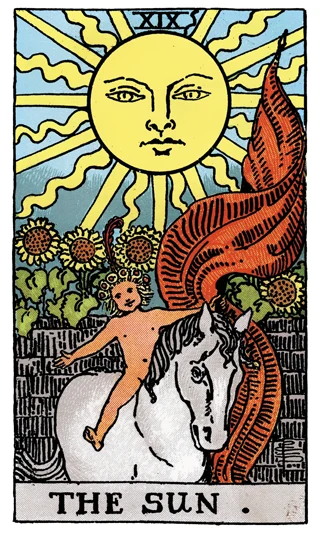
| The large sun | The sun dominates the card with alternating straight and wavering rays. It represents direct consciousness, warmth and an environment in which concealment is difficult. |
| The child | The child embodies openness, simplicity and renewed life. The absence of clothing or armour suggests confidence without defensive status. |
| The white horse | The horse carries instinctive energy in a calm, purified form. No saddle or reins are visible, reinforcing harmony rather than forced control. |
| The red banner | The banner introduces active life, celebration and public visibility. It moves freely above the child rather than functioning as a weapon or boundary. |
| The sunflowers and wall | The flowers turn towards the sun behind a low wall. They show cultivated life responding to illumination while the child moves beyond enclosure. |
A. E. Waite's original description
The naked child mounted on a white horse and displaying a red standard has been mentioned already as the better symbolism connected with this card. It is the destiny of the Supernatural East and the great and holy light which goes before the endless procession of humanity, coming out from the walled garden of the sensitive life and passing on the journey home.
The card signifies, therefore, the transit from the manifest light of this world, represented by the glorious sun of earth, to the light of the world to come, which goes before aspiration and is typified by the heart of a child.
But the last allusion is again the key to a different form or aspect of the symbolism. The sun is that of consciousness in the spirit, the direct as the antithesis of the reflected light. The characteristic type of humanity has become a little child therein, a child in the sense of simplicity and innocence in the sense of wisdom. In that simplicity, he bears the seal of Nature and of Art; in that innocence, he signifies the restored world.
When the self-knowing spirit has dawned in the consciousness above the natural mind, that mind in its renewal leads forth the animal nature in a state of perfect conformity.
Waite's original divinatory meanings
Upright:
Material happiness, fortunate marriage, contentment.
Reversed:
The same in a lesser sense.
Source: A. E. Waite, The Pictorial Key to the Tarot, first published in 1910, with illustrations by Pamela Colman Smith.
Continue through the deck
Written and interpreted by Finbarre Snarey, tarot researcher, founder of the British Tarot Archive and coordinator of the UK living heritage submission for Rider-Waite-Smith tarot reading practice.
These interpretations reflect Finbarre Snarey’s understanding of contemporary Rider-Waite-Smith tarot practice. They are provided for education, reflection and entertainment only and should not be treated as medical, legal, financial, psychological or relationship advice.