The Lovers
Concord
“The course of true love never did run smooth.”
A Midsummer Night’s Dream
The Lovers at a glance
Finbarre’s interpretation: The Lovers represents relationship, attraction and choices that reveal what a person values.
| Upright | love, union, choice, alignment, vulnerability |
|---|---|
| Reversed | disharmony, misalignment, temptation, indecision, incompatible values |
| Linked card | The Tower |
| Soundtrack | Need You Tonight by INXS Open the full Tarot Interviews playlist on Spotify |
Upright meanings
- Love
- Union
- Choice
- Alignment
- Vulnerability
- Mutual recognition
- Shared values
- Honest communication
- Attraction with responsibility
- A consequential decision
Reversed meanings
- Disharmony
- Misalignment
- Temptation
- Indecision
- Incompatible values
- Divided loyalty
- Self-betrayal
- Unspoken conflict
- Attraction without agreement
- A choice being avoided
The Lovers in a reading
| Area | Meaning |
|---|---|
| Love | Relationship energy: Mutual attraction, honesty and chosen commitment. Reversed: Chemistry without compatible values or intentions. |
| Career | Work: Partnership or a values-based career choice. Warning: Collaboration without clear agreement. |
| Money | Financial theme: A shared decision requiring explicit priorities. Warning: Spending or committing solely to please another person. |
| Feelings | Upright: Loving, attracted and willing to be seen. Reversed: Divided, conflicted or tempted away from stated values. |
| Advice | Prioritise: Name the choice beneath the attraction. Watch for: Preserving options at the cost of integrity. |
| Outcome | Potential: A relationship or decision becomes aligned. Obstacle: Incompatibility or avoidance divides the path. |
| Yes or no | Yes, when the choice is consistent with your values. |
Symbols in The Lovers
| Symbol | Meaning |
|---|---|
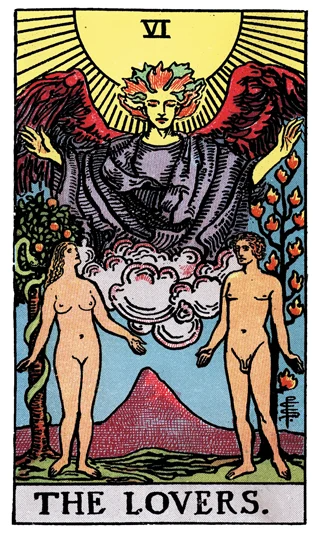
| The angel | The winged figure presides above the couple, placing the relationship within a larger moral or spiritual order. The angel's position also suggests protection and judgement. |
| The naked figures | Their lack of clothing conveys vulnerability, innocence and direct exposure. Nothing material separates them, but their different gazes complicate the flow of attention. |
| The two trees | The Tree of Life stands behind the man, while the tree with the serpent stands behind the woman. Together they evoke knowledge, mortality, desire and consequence. |
| The mountain | The rising ground between the figures can be read as aspiration, challenge or the distance that remains even within intimate union. |
| The sun | The large sun illuminates the entire scene. It suggests consciousness, openness and a relationship brought into full visibility. |
A. E. Waite's original description
The sun shines in the zenith, and beneath is a great winged figure with arms extended, pouring down influences. In the foreground are two human figures, male and female, unveiled before each other, as if Adam and Eve when they first occupied the paradise of the earthly body. Behind the man is the Tree of Life, bearing twelve fruits, and the Tree of the Knowledge of Good and Evil is behind the woman; the serpent is twining round it.
The figures suggest youth, virginity, innocence and love before it is contaminated by gross material desire. This is in all simplicity the card of human love, here exhibited as part of the way, the truth and the life. It replaces, by recourse to first principles, the old card of marriage, which I have described previously, and the later follies which depicted man between vice and virtue. In a very high sense, the card is a mystery of the Covenant and Sabbath.
The suggestion in respect of the woman is that she signifies that attraction towards the sensitive life which carries within it the idea of the Fall of Man, but she is rather the working of a Secret Law of Providence than a willing and conscious temptress. It is through her imputed lapse that man shall arise ultimately, and only by her can he complete himself. The card is therefore in its way another intimation concerning the great mystery of womanhood.
The old meanings fall to pieces of necessity with the old pictures, but even as interpretations of the latter, some of them were of the order of commonplace and others were false in symbolism.
Waite's original divinatory meanings
Upright:
Attraction, love, beauty, trials overcome.
Reversed:
Failure, foolish designs. Another account speaks of marriage frustrated and contrarieties of all kinds.
Source: A. E. Waite, The Pictorial Key to the Tarot, first published in 1910, with illustrations by Pamela Colman Smith.
Continue through the deck
- Previous card: The Hierophant
- Next card: The Chariot
Written and interpreted by Finbarre Snarey, tarot researcher, founder of the British Tarot Archive and coordinator of the UK living heritage submission for Rider-Waite-Smith tarot reading practice.
These interpretations reflect Finbarre Snarey’s understanding of contemporary Rider-Waite-Smith tarot practice. They are provided for education, reflection and entertainment only and should not be treated as medical, legal, financial, psychological or relationship advice.