The Devil
Entanglement
“Hell is empty and all the devils are here.”
The Tempest
The Devil at a glance
Finbarre’s interpretation: The Devil represents bondage, appetite and the power that habits, fear or shame can acquire when left unexamined.
| Upright | bondage, compulsion, appetite, materialism, shadow |
|---|---|
| Reversed | release, exposure, detachment, relapse, fear of freedom |
| Linked card | The Hierophant |
| Soundtrack | Sweet Dreams (Are Made of This) by Eurythmics Open the full Tarot Interviews playlist on Spotify |
Upright meanings
- Bondage
- Compulsion
- Appetite
- Materialism
- The shadow
- Addiction or dependency
- Shame
- A controlling attachment
- Pleasure with a cost
- Participation in an unhealthy pattern
Reversed meanings
- Release
- Exposure
- Detachment
- Relapse
- Fear of freedom
- Recognising the pattern
- Breaking a habit
- Reduced shame
- A chain becoming visible
- Resistance after liberation
The Devil in a reading
| Area | Meaning |
|---|---|
| Love | Relationship energy: Intense attachment, desire or dependency. Reversed: Recognising an unhealthy bond and attempting release. |
| Career | Work: A powerful incentive or environment that compromises freedom. Warning: Status, money or fear becoming a chain. |
| Money | Financial theme: Debt, compulsive consumption or material fixation. Warning: Mistaking possession for security or choice. |
| Feelings | Upright: Obsessed, tempted, ashamed or intensely attached. Reversed: Exposed, conflicted and beginning to detach. |
| Advice | Prioritise: Identify the reward that keeps the pattern in place. Watch for: Treating a removable chain as an unchangeable fate. |
| Outcome | Potential: The attachment becomes undeniable. Obstacle: Shame or fear makes freedom difficult to sustain. |
| Yes or no | No, unless the underlying compulsion or power imbalance is addressed. |
Symbols in The Devil
| Symbol | Meaning |
|---|---|
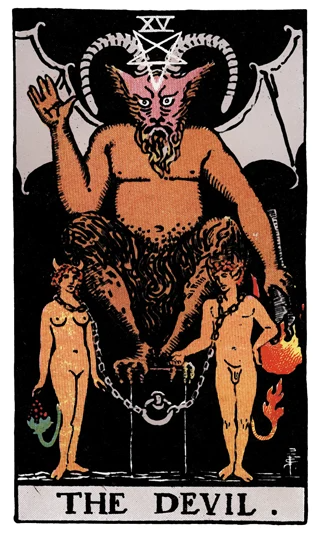
| The loose chains | The chains visibly restrict the figures, but their loops appear large enough to remove. This detail places attention on participation, habituation and the difficulty of choosing freedom. |
| The reversed pentagram | The inverted star above the figure suggests an order turned downward, with appetite or material force placed above reflective consciousness. |
| The torch | The Devil's torch points towards the earth and near the male figure's tail. It suggests energy directed downward into appetite, destruction or material fixation. |
| The tails and horns | The human figures have acquired animal features, showing instinct becoming identity. Their humanity remains visible, so the transformation is not complete or irreversible. |
| The raised hand | The gesture reverses the blessing of The Hierophant. It presents authority as parody, coercion or a sacred form emptied and turned towards domination. |
A. E. Waite's original description
The design is an accommodation, mean or harmony, between several motives mentioned in the first part. The Horned Goat of Mendes, with wings like those of a bat, is standing on an altar. At the pit of the stomach there is the sign of Mercury. The right hand is upraised and extended, being the reverse of that benediction which is given by the Hierophant in the fifth card. In the left hand there is a great flaming torch, inverted towards the earth. A reversed pentagram is on the forehead.
There is a ring in front of the altar, from which two chains are carried to the necks of two figures, male and female. These are analogous with those of the fifth card, as if Adam and Eve after the Fall. Hereof is the chain and fatality of the material life.
The figures are tailed, to signify the animal nature, but there is human intelligence in the faces, and he who is exalted above them is not to be their master for ever. Even now, he is also a bondsman, sustained by the evil that is in him and blind to the liberty of service. With more than his usual derision for the arts which he pretended to respect and interpret as a master therein, Éliphas Lévi affirms that the Baphometic figure is occult science and magic.
Another commentator says that in the Divine world it signifies predestination, but there is no correspondence in that world with the things which below are of the brute. What it does signify is the Dweller on the Threshold without the Mystical Garden when those are driven forth therefrom who have eaten the forbidden fruit.
Waite's original divinatory meanings
Upright:
Ravage, violence, vehemence, extraordinary efforts, force, fatality; that which is predestined but is not for this reason evil.
Reversed:
Evil fatality, weakness, pettiness, blindness.
Source: A. E. Waite, The Pictorial Key to the Tarot, first published in 1910, with illustrations by Pamela Colman Smith.
Continue through the deck
- Previous card: Temperance
- Next card: The Tower
Written and interpreted by Finbarre Snarey, tarot researcher, founder of the British Tarot Archive and coordinator of the UK living heritage submission for Rider-Waite-Smith tarot reading practice.
These interpretations reflect Finbarre Snarey’s understanding of contemporary Rider-Waite-Smith tarot practice. They are provided for education, reflection and entertainment only and should not be treated as medical, legal, financial, psychological or relationship advice.