The Tower
Rupture
“These violent delights have violent ends.”
Romeo and Juliet
The Tower at a glance
Finbarre’s interpretation: The Tower represents sudden disruption, revelation and the collapse of a structure that can no longer contain reality.
| Upright | upheaval, revelation, collapse, shock, liberation |
|---|---|
| Reversed | avoidance, delayed crisis, instability, internal collapse, fear of change |
| Linked card | The Lovers |
| Soundtrack | Cities In Dust - Single Version by Siouxsie and the Banshees Open the full Tarot Interviews playlist on Spotify |
Upright meanings
- Upheaval
- Revelation
- Collapse
- Shock
- Liberation
- A false structure failing
- Sudden truth
- Disruption
- Loss of certainty
- Forced change
Reversed meanings
- Avoidance
- Delayed crisis
- Instability
- Internal collapse
- Fear of change
- A warning being ignored
- Damage contained temporarily
- Private upheaval
- Rebuilding too soon
- Resistance to necessary destruction
The Tower in a reading
| Area | Meaning |
|---|---|
| Love | Relationship energy: A revelation or rupture that changes the bond. Reversed: A crisis being contained, denied or postponed. |
| Career | Work: Sudden restructuring, exposure or system failure. Warning: Rebuilding the same weakness without examining the foundation. |
| Money | Financial theme: Protect essentials during disruption. Warning: Denying instability or assuming the old arrangement can be restored unchanged. |
| Feelings | Upright: Shocked, exposed and unable to maintain the former story. Reversed: Anxious, defensive or bracing against a feared collapse. |
| Advice | Prioritise: Respond to what has been revealed and secure what remains sound. Watch for: Preserving a structure whose failure is the message. |
| Outcome | Potential: A false certainty collapses and releases truth. Obstacle: Avoidance prolongs instability. |
| Yes or no | No for preserving the current structure; change is already underway. |
Symbols in The Tower
| Symbol | Meaning |
|---|---|
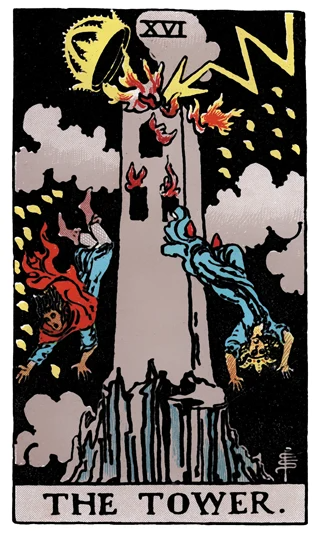
| The lightning strike | The bolt enters suddenly from outside the structure. It suggests revelation, force and an event that bypasses the tower's defences. |
| The falling crown | The crown is removed from the summit, symbolising the loss of authority, certainty or a belief that the structure stood above correction. |
| The falling figures | Two people are expelled into the unknown. Their presence makes the consequences human and shows that false systems still contain living participants. |
| The flames | Fire appears in the windows and as scattered shapes around the tower. It indicates destruction, illumination and energy released from confinement. |
| The isolated height | The tower stands on a steep, barren summit. Its position suggests ambition and separation, but also vulnerability once the single structure fails. |
A. E. Waite's original description
Occult explanations attached to this card are meagre and mostly disconcerting. It is idle to indicate that it depicts ruin in all its aspects, because it bears this evidence on the surface. It is said further that it contains the first allusion to a material building, but I do not conceive that the Tower is more or less material than the pillars which we have met with in three previous cases.
I see nothing to warrant Papus in supposing that it is literally the fall of Adam, but there is more in favour of his alternative, that it signifies the materialization of the spiritual word. The bibliographer Christian imagines that it is the downfall of the mind, seeking to penetrate the mystery of God. I agree rather with Grand Orient that it is the ruin of the House of We, when evil has prevailed therein, and above all that it is the rending of a House of Doctrine.
I understand that the reference is, however, to a House of Falsehood. It illustrates also in the most comprehensive way the old truth that “except the Lord build the house, they labour in vain that build it.”
There is a sense in which the catastrophe is a reflection from the previous card, but not on the side of the symbolism which I have tried to indicate therein. It is more correctly a question of analogy; one is concerned with the fall into the material and animal state, while the other signifies destruction on the intellectual side.
The Tower has been spoken of as the chastisement of pride and the intellect overwhelmed in the attempt to penetrate the Mystery of God; but in neither case do these explanations account for the two persons who are the living sufferers. The one is the literal word made void and the other its false interpretation. In yet a deeper sense, it may signify also the end of a dispensation, but there is no possibility here for the consideration of this involved question.
Waite's original divinatory meanings
Upright:
Misery, distress, indigence, adversity, calamity, disgrace, deception, ruin. It is a card in particular of unforeseen catastrophe.
Reversed:
According to one account, the same in a lesser degree; also oppression, imprisonment, tyranny.
Source: A. E. Waite, The Pictorial Key to the Tarot, first published in 1910, with illustrations by Pamela Colman Smith.
Continue through the deck
Written and interpreted by Finbarre Snarey, tarot researcher, founder of the British Tarot Archive and coordinator of the UK living heritage submission for Rider-Waite-Smith tarot reading practice.
These interpretations reflect Finbarre Snarey’s understanding of contemporary Rider-Waite-Smith tarot practice. They are provided for education, reflection and entertainment only and should not be treated as medical, legal, financial, psychological or relationship advice.