Temperance
Calibration
“Nothing in excess.”
Delphic maxim
Temperance at a glance
Finbarre’s interpretation: Temperance represents balance created through patient adjustment, integration and the mixing of different elements.
| Upright | balance, integration, moderation, healing, adjustment |
|---|---|
| Reversed | excess, imbalance, conflict, poor combination, impatience |
| Linked card | The Chariot |
| Soundtrack | A Case of You by Joni Mitchell Open the full Tarot Interviews playlist on Spotify |
Upright meanings
- Balance
- Integration
- Moderation
- Healing
- Adjustment
- Patient coordination
- A workable compromise
- Blending different elements
- Steady recovery
- Sustainable rhythm
Reversed meanings
- Excess
- Imbalance
- Conflict
- Poor combination
- Impatience
- Extremes
- Failed compromise
- Disrupted recovery
- Incompatible elements
- Overcorrection
Temperance in a reading
| Area | Meaning |
|---|---|
| Love | Relationship energy: Patient adjustment and healthy compromise. Reversed: Extremes, poor blending or recurring incompatibility. |
| Career | Work: Coordination, integration and gradual improvement. Warning: Combining roles or ideas that need clearer boundaries. |
| Money | Financial theme: Moderation and a sustainable plan. Warning: Overcorrection, excess or inconsistent habits. |
| Feelings | Upright: Calm, measured and willing to adapt. Reversed: Impatient, conflicted or emotionally out of balance. |
| Advice | Prioritise: Adjust gradually until the elements work together. Watch for: Seeking harmony by erasing necessary differences. |
| Outcome | Potential: Patient calibration creates a stable mixture. Obstacle: Extremes or haste prevent integration. |
| Yes or no | Yes, if approached gradually and in moderation. |
Symbols in Temperance
| Symbol | Meaning |
|---|---|
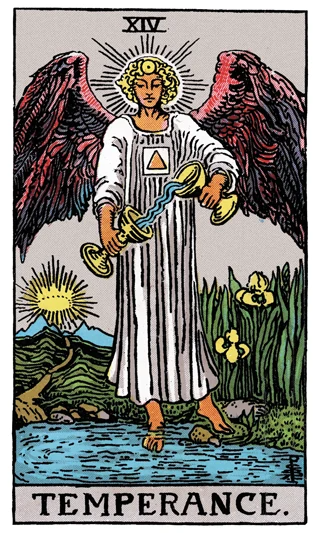
| The two cups | The liquid moves between separate vessels in an apparently impossible flow. The image represents exchange, adaptation and the creation of continuity between distinct forms. |
| One foot on land and one in water | The stance connects material and emotional domains. It suggests participation in both without being overwhelmed by either. |
| The path and distant crown | A clear path leads towards mountains and a radiant crown. Integration in the foreground becomes part of a longer movement towards purpose or illumination. |
| The triangle within the square | The emblem on the robe combines a triangle and square, often read as spirit within matter. It reinforces the card's concern with bringing different orders into relationship. |
| The irises | The flowers near the water introduce beauty and living growth. Their presence suggests that harmony produces more than neutrality; it supports flourishing. |
A. E. Waite's original description
A winged angel, with the sign of the sun upon his forehead and on his breast the square and triangle of the septenary. I speak of him in the masculine sense, but the figure is neither male nor female. It is held to be pouring the essences of life from chalice to chalice. It has one foot upon the earth and one upon waters, thus illustrating the nature of the essences.
A direct path goes up to certain heights on the verge of the horizon, and above there is a great light, through which a crown is seen vaguely. Hereof is some part of the Secret of Eternal Life, as it is possible to man in his incarnation. All the conventional emblems are renounced herein.
So also are the conventional meanings, which refer to changes in the seasons, perpetual movement of life and even the combination of ideas. It is, moreover, untrue to say that the figure symbolizes the genius of the sun, though it is the analogy of solar light, realized in the third part of our human triplicity. It is called Temperance fantastically, because, when the rule of it obtains in our consciousness, it tempers, combines and harmonises the psychic and material natures.
Under that rule we know in our rational part something of whence we came and whither we are going.
Waite's original divinatory meanings
Upright:
Economy, moderation, frugality, management, accommodation.
Reversed:
Things connected with churches, religions, sects, the priesthood, sometimes even the priest who will marry the Querent; also disunion, unfortunate combinations, competing interests.
Source: A. E. Waite, The Pictorial Key to the Tarot, first published in 1910, with illustrations by Pamela Colman Smith.
Continue through the deck
Written and interpreted by Finbarre Snarey, tarot researcher, founder of the British Tarot Archive and coordinator of the UK living heritage submission for Rider-Waite-Smith tarot reading practice.
These interpretations reflect Finbarre Snarey’s understanding of contemporary Rider-Waite-Smith tarot practice. They are provided for education, reflection and entertainment only and should not be treated as medical, legal, financial, psychological or relationship advice.