Death
Shedding
“Nothing of him that doth fade, but doth suffer a sea-change into something rich and strange.”
William Shakespeare, The Tempest
Death at a glance
Finbarre’s interpretation: Death represents endings, transition and the transformation that follows when an old form can no longer continue.
| Upright | ending, transition, release, transformation, renewal |
|---|---|
| Reversed | resistance, stagnation, delayed ending, inertia, fear of change |
| Linked card | The Empress |
| Soundtrack | Into My Arms by Nick Cave & The Bad Seeds Open the full Tarot Interviews playlist on Spotify |
Upright meanings
- An ending
- Transformation
- Release
- Irreversible change
- A transition
- Shedding an old identity
- Closure
- Clearing what is finished
- Renewal through loss
- A necessary passage
Reversed meanings
- Resistance to change
- Stagnation
- Delayed ending
- Fear of loss
- Clinging to the past
- Incomplete closure
- Repeated decay
- Avoidance of transition
- A change being prolonged
- Inability to release
Death in a reading
| Area | Meaning |
|---|---|
| Love | Relationship energy: A relationship or phase changes beyond return. Reversed: Clinging to a bond or pattern that has already ended in practice. |
| Career | Work: A role, project or identity reaches its conclusion. Warning: Prolonging decline because change feels threatening. |
| Money | Financial theme: End an unsustainable arrangement and reorganise. Warning: Refusing to cut losses or release obsolete commitments. |
| Feelings | Upright: Ready to let go, grieving or profoundly changed. Reversed: Resistant, fearful or unable to accept finality. |
| Advice | Prioritise: Name what is over and make room for the next state. Watch for: Treating transformation as negotiable when the old form has already gone. |
| Outcome | Potential: A decisive ending creates renewal. Obstacle: Resistance prolongs stagnation and decay. |
| Yes or no | No to continuation in its present form; yes to necessary change. |
Symbols in Death
| Symbol | Meaning |
|---|---|
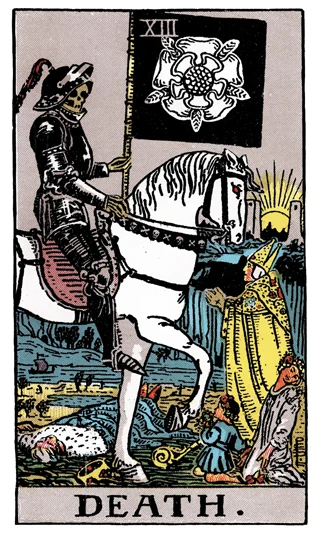
| The skeleton | The rider reduces identity to the structure that remains beneath social difference. The armour makes death impersonal and resistant to negotiation. |
| The white horse | The pale horse carries the transformation forward with calm momentum. White can suggest purification, clarity or the neutrality of natural process. |
| The black banner and white rose | The flag combines darkness with a living five-petalled rose. The image holds ending and renewal within the same emblem. |
| The fallen figures | King, child and maiden respond differently, while the cleric faces the rider. The scene shows that change reaches every rank and stage of life. |
| The rising sun | Between distant pillars, the sun appears on the horizon. It presents death as passage towards another state rather than a closed void. |
A. E. Waite's original description
The veil or mask of life is perpetuated in change, transformation and passage from lower to higher, and this is more fitly represented in the rectified Tarot by one of the apocalyptic visions than by the crude notion of the reaping skeleton. Behind it lies the whole world of ascent in the spirit. The mysterious horseman moves slowly, bearing a black banner emblazoned with the Mystic Rose, which signifies life. Between two pillars on the verge of the horizon there shines the sun of immortality.
The horseman carries no visible weapon, but king and child and maiden fall before him, while a prelate with clasped hands awaits his end.
There should be no need to point out that the suggestion of death which I have made in connexion with the previous card is, of course, to be understood mystically, but this is not the case in the present instance.
The natural transit of man to the next stage of his being either is or may be one form of his progress, but the exotic and almost unknown entrance, while still in this life, into the state of mystical death is a change in the form of consciousness and the passage into a state to which ordinary death is neither the path nor gate. The existing occult explanations of the 13th card are, on the whole, better than usual, rebirth, creation, destination, renewal, and the rest.
Waite's original divinatory meanings
Upright:
End, mortality, destruction, corruption; also, for a man, the loss of a benefactor; for a woman, many contrarieties; for a maid, failure of marriage projects.
Reversed:
Inertia, sleep, lethargy, petrifaction, somnambulism; hope destroyed.
Source: A. E. Waite, The Pictorial Key to the Tarot, first published in 1910, with illustrations by Pamela Colman Smith.
Continue through the deck
- Previous card: The Hanged Man
- Next card: Temperance
Written and interpreted by Finbarre Snarey, tarot researcher, founder of the British Tarot Archive and coordinator of the UK living heritage submission for Rider-Waite-Smith tarot reading practice.
These interpretations reflect Finbarre Snarey’s understanding of contemporary Rider-Waite-Smith tarot practice. They are provided for education, reflection and entertainment only and should not be treated as medical, legal, financial, psychological or relationship advice.