The Hanged Man
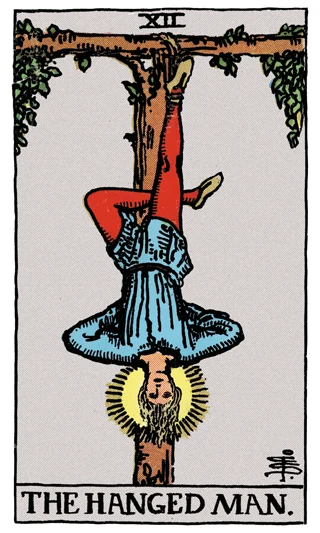
Reorientation
“I am rooted, but I flow.”
Virginia Woolf, The Waves
The Hanged Man at a glance
Finbarre’s interpretation: The Hanged Man represents suspension, surrender and the altered perspective that becomes possible when ordinary action stops.
| Upright | suspension, surrender, perspective, sacrifice, pause |
|---|---|
| Reversed | stalling, resistance, martyrdom, indecision, wasted sacrifice |
| Linked card | The High Priestess |
| Soundtrack | Just Dropped In (To See What Condition My Condition Is In) by Kenny Rogers & The First Edition Open the full Tarot Interviews playlist on Spotify |
Upright meanings
- Pause
- Surrender
- A changed perspective
- Voluntary suspension
- Reassessment
- Letting go of control
- A productive delay
- Sacrifice for insight
- Seeing the situation differently
- Waiting without passivity
Reversed meanings
- Stagnation
- Martyrdom
- Resistance
- Pointless delay
- Indecision
- Sacrifice without purpose
- Refusal to change perspective
- Avoidance disguised as patience
- Being stuck
- Trying to force release
The Hanged Man in a reading
| Area | Meaning |
|---|---|
| Love | Relationship energy: A pause that changes how the bond is understood. Reversed: Limbo, martyrdom or delay without honest purpose. |
| Career | Work: Reassessment and a temporary suspension of action. Warning: Remaining stuck because a familiar viewpoint feels safer. |
| Money | Financial theme: Delay major action while assumptions are reviewed. Warning: Sacrificing resources without a clear reason or endpoint. |
| Feelings | Upright: Reflective, suspended and willing to see differently. Reversed: Trapped, resentful or tired of waiting. |
| Advice | Prioritise: Release the need to control the timing and examine the inverted view. Watch for: Mistaking inertia for surrender. |
| Outcome | Potential: A pause produces insight and reorientation. Obstacle: Resistance turns suspension into stagnation. |
| Yes or no | Not yet; the situation needs a different perspective before movement. |
Symbols in The Hanged Man
| Symbol | Meaning |
|---|---|
| The living wooden frame | Leaves grow from the structure, showing that suspension occurs within life rather than death. The apparent instrument of punishment is also a living tree. |
| The halo | The bright nimbus indicates illumination or altered consciousness. It shifts attention from the body's position to the mind's experience. |
| The crossed legs | The legs form a distinctive hooked shape while the arms create another triangle behind the body. The geometry makes the figure appear composed rather than chaotic. |
| The calm face | The expression contains no visible agony. This detail is central to reading the card as willing suspension, entrancement or spiritual reversal. |
| The blue and red clothing | The colours combine cool reflection with active vitality. The body is still, but energy has not disappeared. |
A. E. Waite's original description
The gallows from which he is suspended forms a Tau cross, while the figure, from the position of the legs, forms a fylfot cross. There is a nimbus about the head of the seeming martyr. It should be noted (1) that the tree of sacrifice is living wood, with leaves thereon; (2) that the face expresses deep entrancement, not suffering; (3) that the figure, as a whole, suggests life in suspension, but life and not death. It is a card of profound significance, but all the significance is veiled.
One of his editors suggests that Éliphas Lévi did not know the meaning, which is unquestionable, nor did the editor himself. It has been called falsely a card of martyrdom, a card of prudence, a card of the Great Work, a card of duty; but we may exhaust all published interpretations and find only vanity. I will say very simply on my own part that it expresses the relation, in one of its aspects, between the Divine and the Universe.
He who can understand that the story of his higher nature is imbedded in this symbolism will receive intimations concerning a great awakening that is possible, and will know that after the sacred Mystery of Death there is a glorious Mystery of Resurrection.
Waite's original divinatory meanings
Upright:
Wisdom, circumspection, discernment, trials, sacrifice, intuition, divination, prophecy.
Reversed:
Selfishness, the crowd, body politic.
Source: A. E. Waite, The Pictorial Key to the Tarot, first published in 1910, with illustrations by Pamela Colman Smith.
Continue through the deck
Written and interpreted by Finbarre Snarey, tarot researcher, founder of the British Tarot Archive and coordinator of the UK living heritage submission for Rider-Waite-Smith tarot reading practice.
These interpretations reflect Finbarre Snarey’s understanding of contemporary Rider-Waite-Smith tarot practice. They are provided for education, reflection and entertainment only and should not be treated as medical, legal, financial, psychological or relationship advice.