Justice
Measure
“The quality of mercy is not strain’d.”
The Merchant of Venice
Justice at a glance
Finbarre’s interpretation: Justice represents accountability, fairness and the consequences of decisions made in the light of evidence.
| Upright | fairness, truth, accountability, evidence, consequence |
|---|---|
| Reversed | bias, dishonesty, unfairness, evasion, excessive severity |
| Linked card | The Magician |
| Soundtrack | What's Up? by 4 Non Blondes Open the full Tarot Interviews playlist on Spotify |
Upright meanings
- Fairness
- Accountability
- Truth
- Cause and effect
- A balanced decision
- Legal or contractual matters
- Evidence
- Proportionate consequences
- Integrity
- Clear judgement
Reversed meanings
- Unfairness
- Avoided accountability
- Bias
- Dishonesty
- Disproportionate consequence
- Legal complication
- Poor evidence
- Self-justification
- An unbalanced decision
- Refusal to face facts
Justice in a reading
| Area | Meaning |
|---|---|
| Love | Relationship energy: Honest agreements and mutual accountability. Reversed: Blame, imbalance or facts being selectively presented. |
| Career | Work: Contracts, policy, evaluation and evidence-based decisions. Warning: Bias or procedure being applied inconsistently. |
| Money | Financial theme: Settle accounts and examine obligations. Warning: Hidden terms, penalties or avoidance of responsibility. |
| Feelings | Upright: Clear, measured and prepared to be fair. Reversed: Resentful, defensive or unwilling to accept consequences. |
| Advice | Prioritise: Use evidence and apply the same standard to everyone involved. Watch for: Calling a preferred outcome fair because it benefits you. |
| Outcome | Potential: A proportionate decision or settlement. Obstacle: Bias, dishonesty or incomplete evidence distorts the result. |
| Yes or no | Yes, if the facts and obligations support it. |
Symbols in Justice
| Symbol | Meaning |
|---|---|
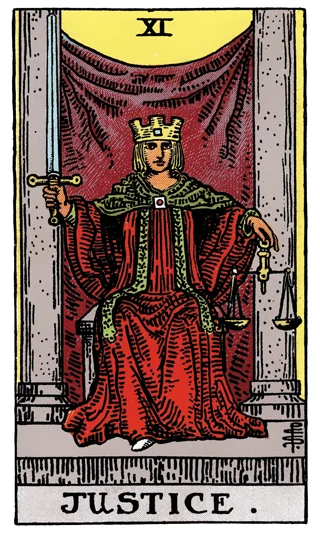
| The scales | The scales represent comparison, evidence and proportion. They are held level, suggesting an active effort to balance competing claims. |
| The upright sword | The sword signifies decision, clarity and enforcement. Its double edge warns that judgement applies in more than one direction. |
| The pillars | The seated figure occupies a formal threshold similar to the High Priestess. Here, however, the concern is manifest moral and legal order rather than concealed knowledge. |
| The red robe | The strong red garment gives the figure authority and visible presence. It contrasts with the measured stillness of the pose. |
| The square clasp and crown | The geometric details reinforce reason, structure and the attempt to make judgement stable rather than impulsive. |
A. E. Waite's original description
As this card follows the traditional symbolism and carries above all its obvious meanings, there is little to say regarding it outside the few considerations collected in the first part, to which the reader is referred.
It will be seen, however, that the figure is seated between pillars, like the High Priestess, and on this account it seems desirable to indicate that the moral principle which deals unto every man according to his works, while, of course, it is in strict analogy with higher things, differs in its essence from the spiritual justice which is involved in the idea of election.
The latter belongs to a mysterious order of Providence, in virtue of which it is possible for certain men to conceive the idea of dedication to the highest things. The operation of this is like the breathing of the Spirit where it wills, and we have no canon of criticism or ground of explanation concerning it. It is analogous to the possession of the fairy gifts and the high gifts and the gracious gifts of the poet: we have them or have not, and their presence is as much a mystery as their absence.
The law of Justice is not however involved by either alternative. In conclusion, the pillars of Justice open into one world and the pillars of the High Priestess into another.
Waite's original divinatory meanings
Upright:
Equity, rightness, probity, executive; triumph of the deserving side in law.
Reversed:
Law in all its departments, legal complications, bigotry, bias, excessive severity.
Source: A. E. Waite, The Pictorial Key to the Tarot, first published in 1910, with illustrations by Pamela Colman Smith.
Continue through the deck
- Previous card: Wheel of Fortune
- Next card: The Hanged Man
Written and interpreted by Finbarre Snarey, tarot researcher, founder of the British Tarot Archive and coordinator of the UK living heritage submission for Rider-Waite-Smith tarot reading practice.
These interpretations reflect Finbarre Snarey’s understanding of contemporary Rider-Waite-Smith tarot practice. They are provided for education, reflection and entertainment only and should not be treated as medical, legal, financial, psychological or relationship advice.