Wheel of Fortune
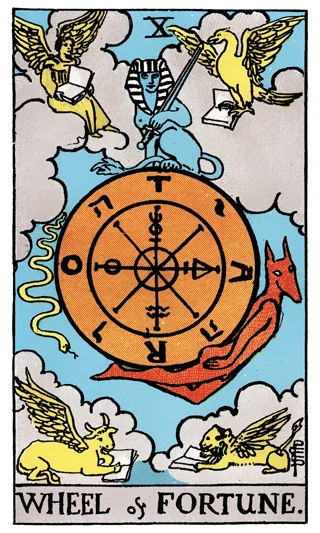
Vicissitude
“The wheel is come full circle.”
King Lear
Wheel of Fortune at a glance
Finbarre’s interpretation: Wheel of Fortune represents changing circumstances, recurring cycles and a turning point that cannot be held still.
| Upright | change, cycle, turning point, opportunity, momentum |
|---|---|
| Reversed | resistance, setback, repetition, instability, poor timing |
| Linked card | Judgement |
| Soundtrack | You Spin Me Round (Like a Record) by Dead Or Alive Open the full Tarot Interviews playlist on Spotify |
Upright meanings
- A turning point
- Change of circumstances
- Opportunity
- Movement
- A new cycle
- Unexpected development
- Improved timing
- Momentum beyond personal control
- Adaptation
- Fortune shifting
Reversed meanings
- Setback
- Resistance to change
- Poor timing
- Repeated pattern
- Loss of control
- Temporary decline
- A missed opening
- Bad luck
- Stagnation within a cycle
- Refusal to adapt
Wheel of Fortune in a reading
| Area | Meaning |
|---|---|
| Love | Relationship energy: A turning point or change in circumstances. Reversed: An old pattern repeating or timing working against the connection. |
| Career | Work: An unexpected opening, transition or change of direction. Warning: Treating temporary fortune as permanent security. |
| Money | Financial theme: Fluctuation and changing conditions. Warning: Gambling on luck or resisting necessary adjustment. |
| Feelings | Upright: Hopeful, surprised and ready for change. Reversed: Unsettled, unlucky or trapped in repetition. |
| Advice | Prioritise: Respond intelligently to the turn already underway. Watch for: Trying to freeze a cycle at its most favourable point. |
| Outcome | Potential: Circumstances shift and create movement. Obstacle: Resistance or poor timing prolongs the cycle. |
| Yes or no | Yes, but conditions may change quickly. |
Symbols in Wheel of Fortune
| Symbol | Meaning |
|---|---|
| The wheel | The central wheel presents life as movement, recurrence and shifting position. Its multiple rings suggest that visible events are connected with deeper systems. |
| The sphinx | The sphinx sits above the turning wheel with a sword. It represents stability, judgement and an intelligence that remains poised amid change. |
| The serpent and ascending figure | One form descends while another rises. Together they show loss and gain as simultaneous parts of the same motion. |
| The letters and symbols | The wheel carries letters that can be read in several sequences alongside alchemical signs. Their arrangement reinforces transformation and layered order. |
| The four winged creatures | The figures in the corners read books while surrounded by cloud. They suggest enduring witnesses, fixed signs or forms of knowledge that frame the wheel's instability. |
A. E. Waite's original description
In this symbol I have again followed the reconstruction of Éliphas Lévi, who has furnished several variants. It is legitimate, as I have intimated, to use Egyptian symbolism when this serves our purpose, provided that no theory of origin is implied therein. I have, however, presented Typhon in his serpent form.
The symbolism is, of course, not exclusively Egyptian, as the four Living Creatures of Ezekiel occupy the angles of the card, and the wheel itself follows other indications of Lévi in respect of Ezekiel's vision, as illustrative of the particular Tarot Key. With the French occultist, and in the design itself, the symbolic picture stands for the perpetual motion of a fluidic universe and for the flux of human life. The Sphinx is the equilibrium therein.
The transliteration of Taro as Rota is inscribed on the wheel, counterchanged with the letters of the Divine Name, to shew that Providence is implied through all. But this is the Divine intention within, and the similar intention without is exemplified by the four Living Creatures. Sometimes the sphinx is represented couchant on a pedestal above, which defrauds the symbolism by stultifying the essential idea of stability amidst movement.
Behind the general notion expressed in the symbol there lies the denial of chance and the fatality which is implied therein. It may be added that, from the days of Lévi onward, the occult explanations of this card are, even for occultism itself, of a singularly fatuous kind. It has been said to mean principle, fecundity, virile honour, ruling authority, etc. The findings of common fortune-telling are better than this on their own plane.
Waite's original divinatory meanings
Upright:
Destiny, fortune, success, elevation, luck, felicity.
Reversed:
Increase, abundance, superfluity.
Source: A. E. Waite, The Pictorial Key to the Tarot, first published in 1910, with illustrations by Pamela Colman Smith.
Continue through the deck
- Previous card: The Hermit
- Next card: Justice
Written and interpreted by Finbarre Snarey, tarot researcher, founder of the British Tarot Archive and coordinator of the UK living heritage submission for Rider-Waite-Smith tarot reading practice.
These interpretations reflect Finbarre Snarey’s understanding of contemporary Rider-Waite-Smith tarot practice. They are provided for education, reflection and entertainment only and should not be treated as medical, legal, financial, psychological or relationship advice.