The Hermit
Seclusion
The Hermit at a glance
Finbarre’s interpretation: The Hermit represents purposeful solitude, reflection and guidance earned through experience.
| Upright | solitude, reflection, wisdom, guidance, discernment |
|---|---|
| Reversed | isolation, avoidance, concealment, loneliness, excessive caution |
| Linked card | The Star |
| Soundtrack | The Passenger by Iggy Pop Open the full Tarot Interviews playlist on Spotify |
Upright meanings
- Purposeful solitude
- Reflection
- Wisdom
- Guidance
- Discernment
- Research
- Private work
- Mentorship
- Distance from distraction
- An answer earned through experience
Reversed meanings
- Isolation
- Avoidance
- Concealment
- Loneliness
- Excessive caution
- Withdrawal from support
- Refusal to re-engage
- Overthinking
- Poor guidance
- Solitude becoming stagnation
The Hermit in a reading
| Area | Meaning |
|---|---|
| Love | Relationship energy: Space for reflection or a mature, quiet bond. Reversed: Emotional withdrawal, loneliness or avoidance of intimacy. |
| Career | Work: Research, specialist practice and independent concentration. Warning: Working in isolation beyond the point of usefulness. |
| Money | Financial theme: Conservative review and experienced guidance. Warning: Fear preventing any decision or necessary engagement. |
| Feelings | Upright: Thoughtful, private and discerning. Reversed: Lonely, closed off or unwilling to ask for help. |
| Advice | Prioritise: Reduce noise and seek the answer that experience supports. Watch for: Turning retreat into permanent disappearance. |
| Outcome | Potential: Solitude produces clarity and useful guidance. Obstacle: Isolation becomes avoidance or stagnation. |
| Yes or no | Not immediately; step back and examine the situation first. |
Symbols in The Hermit
| Symbol | Meaning |
|---|---|
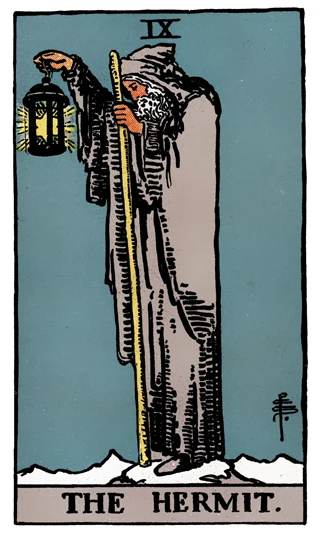
| The lantern | The lantern contains a six-pointed star and illuminates only a limited area. It suggests guidance sufficient for the next step rather than total knowledge of the route. |
| The mountain | The elevated setting implies attainment, difficulty and distance from ordinary activity. The figure has reached a vantage point, but the landscape is cold and sparse. |
| The staff | The staff supports the traveller and marks practical experience. It also resembles the wand as a simple instrument of directed will. |
| The grey cloak | The muted garment withdraws the figure from display. It suggests seriousness, anonymity and a life temporarily stripped of distraction. |
| The bowed head | The Hermit's posture is reflective rather than triumphant. Wisdom is presented as attention and humility, not certainty performed for an audience. |
A. E. Waite's original description
The variation from the conventional models in this card is only that the lamp is not enveloped partially in the mantle of its bearer, who blends the idea of the Ancient of Days with the Light of the World. It is a star which shines in the lantern. I have said that this is a card of attainment, and to extend this conception the figure is seen holding up his beacon on an eminence.
Therefore the Hermit is not, as Court de Gebelin explained, a wise man in search of truth and justice; nor is he, as a later explanation proposes, an especial example of experience. His beacon intimates that “where I am, you also may be.”
It is further a card which is understood quite incorrectly when it is connected with the idea of occult isolation, as the protection of personal magnetism against admixture. This is one of the frivolous renderings which we owe to Éliphas Lévi. It has been adopted by the French Order of Martinism and some of us have heard a great deal of the Silent and Unknown Philosophy enveloped by his mantle from the knowledge of the profane. In true Martinism, the significance of the term Philosophe inconnu was of another order. It did not refer to the intended concealment of the Instituted Mysteries, much less of their substitutes, but, like the card itself, to the truth that the Divine Mysteries secure their own protection from those who are unprepared.
Waite's original divinatory meanings
Upright:
Prudence, circumspection; also and especially treason, dissimulation, roguery, corruption.
Reversed:
Concealment, disguise, policy, fear, unreasoned caution.
Source: A. E. Waite, The Pictorial Key to the Tarot, first published in 1910, with illustrations by Pamela Colman Smith.
Continue through the deck
- Previous card: Strength
- Next card: Wheel of Fortune
Written and interpreted by Finbarre Snarey, tarot researcher, founder of the British Tarot Archive and coordinator of the UK living heritage submission for Rider-Waite-Smith tarot reading practice.
These interpretations reflect Finbarre Snarey’s understanding of contemporary Rider-Waite-Smith tarot practice. They are provided for education, reflection and entertainment only and should not be treated as medical, legal, financial, psychological or relationship advice.