Judgement
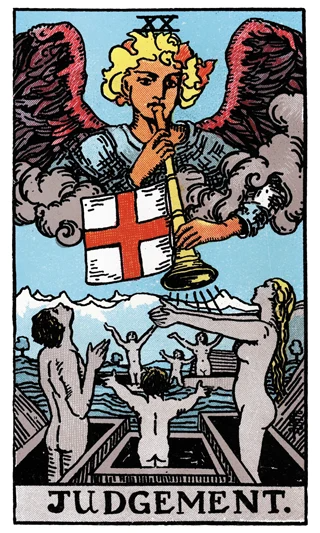
Recall
“The truth will out.”
The Merchant of Venice
Judgement at a glance
Finbarre’s interpretation: Judgement represents awakening, reckoning and the moment when a call for change can no longer be ignored.
| Upright | awakening, renewal, reckoning, calling, decision |
|---|---|
| Reversed | self-doubt, refusal, harsh judgement, indecision, repetition |
| Linked card | The Wheel Of Fortune |
| Soundtrack | When Doves Cry by Prince Open the full Tarot Interviews playlist on Spotify |
Upright meanings
- Awakening
- Renewal
- Reckoning
- A calling
- Decision
- A second chance
- Self-evaluation
- Answering what can no longer be ignored
- Release from an old identity
- Consequences becoming clear
Reversed meanings
- Self-doubt
- Refusal
- Harsh judgement
- Indecision
- Repetition
- Ignoring the call
- Fear of evaluation
- Failure to learn
- A decision postponed
- Condemnation without renewal
Judgement in a reading
| Area | Meaning |
|---|---|
| Love | Relationship energy: An honest reckoning, renewal or decisive second chance. Reversed: Repeating the past or refusing the necessary conversation. |
| Career | Work: A calling, evaluation or decision that changes direction. Warning: Self-doubt preventing a clear response to opportunity. |
| Money | Financial theme: Review the full history and make a corrective decision. Warning: Repeating a known mistake or avoiding accountability. |
| Feelings | Upright: Awakened, accountable and ready to answer. Reversed: Judged, doubtful or unwilling to face the decision. |
| Advice | Prioritise: Respond to the call and use the past as evidence rather than a prison. Watch for: Confusing accountability with permanent condemnation. |
| Outcome | Potential: A decisive awakening permits renewal. Obstacle: Refusal or self-doubt keeps the old cycle active. |
| Yes or no | Yes, if you are prepared to answer honestly and change accordingly. |
Symbols in Judgement
| Symbol | Meaning |
|---|---|
| The trumpet | The angel's instrument broadcasts a call that reaches every figure. It represents announcement, awakening and a message that cannot remain private. |
| The flag and cross | The banner connects the scene with resurrection and spiritual judgement. It gives the call an authority larger than personal preference. |
| The rising figures | Adults and children respond with raised arms. Their shared posture suggests collective wonder and the return of life from confinement. |
| The coffins | The figures rise from rectangular enclosures floating on water. The old state is visibly opened, but not erased from the scene. |
| The distant mountains | The cold peaks create a final boundary on the horizon. They make the scene feel universal and remove the possibility of returning to an ordinary landscape unchanged. |
A. E. Waite's original description
I have said that this symbol is essentially invariable in all Tarot sets, or at least the variations do not alter its character. The great angel is here encompassed by clouds, but he blows his bannered trumpet, and the cross as usual is displayed on the banner. The dead are rising from their tombs, a woman on the right, a man on the left hand, and between them their child, whose back is turned.
But in this card there are more than three who are restored, and it has been thought worth while to make this variation as illustrating the insufficiency of current explanations. It should be noted that all the figures are as one in the wonder, adoration and ecstasy expressed by their attitudes. It is the card which registers the accomplishment of the great work of transformation in answer to the summons of the Supernal, which summons is heard and answered from within.
Herein is the intimation of a significance which cannot well be carried further in the present place. What is that within us which does sound a trumpet and all that is lower in our nature rises in response, almost in a moment, almost in the twinkling of an eye? Let the card continue to depict, for those who can see no further, the Last Judgment and the resurrection in the natural body; but let those who have inward eyes look and discover therewith.
They will understand that it has been called truly in the past a card of eternal life, and for this reason it may be compared with that which passes under the name of Temperance.
Waite's original divinatory meanings
Upright:
Change of position, renewal, outcome. Another account specifies total loss through lawsuit.
Reversed:
Weakness, pusillanimity, simplicity; also deliberation, decision, sentence.
Source: A. E. Waite, The Pictorial Key to the Tarot, first published in 1910, with illustrations by Pamela Colman Smith.
Continue through the deck
Written and interpreted by Finbarre Snarey, tarot researcher, founder of the British Tarot Archive and coordinator of the UK living heritage submission for Rider-Waite-Smith tarot reading practice.
These interpretations reflect Finbarre Snarey’s understanding of contemporary Rider-Waite-Smith tarot practice. They are provided for education, reflection and entertainment only and should not be treated as medical, legal, financial, psychological or relationship advice.