The Hierophant
Lineage
“Ask, and it shall be given you; seek, and ye shall find.”
Matthew 7:7
The Hierophant at a glance
Finbarre’s interpretation: The Hierophant represents tradition, teaching and knowledge transmitted through recognised institutions.
| Upright | tradition, teaching, institution, ceremony, shared values |
|---|---|
| Reversed | dogma, nonconformity, restrictive belief, poor guidance, rebellion |
| Linked card | The Devil |
| Soundtrack | Like a Prayer by Madonna Open the full Tarot Interviews playlist on Spotify |
Upright meanings
- Tradition
- Teaching
- Institution
- Ceremony
- Shared values
- Formal commitment
- Mentorship
- Professional standards
- Inherited knowledge
- Belonging through practice
Reversed meanings
- Dogma
- Nonconformity
- Restrictive belief
- Poor guidance
- Rebellion
- Gatekeeping
- Empty ritual
- Institutional hypocrisy
- Independent study
- A break with convention
The Hierophant in a reading
| Area | Meaning |
|---|---|
| Love | Relationship energy: Commitment, marriage or shared values. Reversed: A relationship that rejects or is constrained by convention. |
| Career | Work: Training, mentorship and recognised standards. Warning: Bureaucracy or status replacing useful expertise. |
| Money | Financial theme: Seek appropriately qualified guidance. Warning: Deferring automatically to authority. |
| Feelings | Upright: Loyal, respectful and commitment-minded. Reversed: Restricted, rebellious or unwilling to follow inherited rules. |
| Advice | Prioritise: Learn what the tradition preserves before changing it. Watch for: Obedience demanded without explanation. |
| Outcome | Potential: Formal recognition or commitment. Obstacle: Dogma, gatekeeping or reflexive rebellion. |
| Yes or no | Yes, especially for formal agreements, study or conventional commitments. |
Symbols in The Hierophant
| Symbol | Meaning |
|---|---|
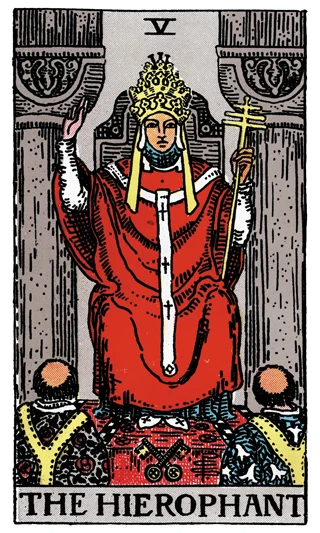
| The triple crown | The layered crown establishes religious and institutional authority. It suggests a hierarchy that connects different levels of doctrine or office. |
| The raised hand | The gesture of blessing distinguishes what is openly communicated from what remains concealed. It also mirrors, but differs from, the Magician's directing gesture. |
| The crossed keys | The keys suggest access, permission and the authority to open or close a sacred domain. They also represent the power held by an institution's gatekeepers. |
| The two kneeling figures | The ministers show teaching as a relationship between office and followers. Their presence raises questions about initiation, obedience and transmission. |
| The floral garments | The roses and lilies repeat imagery from The Magician, but here the symbols are worn by followers within an organised system rather than cultivated by a solitary adept. |
A. E. Waite's original description
He wears the triple crown and is seated between two pillars, but they are not those of the Temple which is guarded by the High Priestess. In his left hand he holds a sceptre terminating in the triple cross, and with his right hand he gives the well-known ecclesiastical sign which is called that of esotericism, distinguishing between the manifest and concealed part of doctrine. It is noticeable in this connexion that the High Priestess makes no sign.
At his feet are the crossed keys, and two priestly ministers in albs kneel before him. He has been usually called the Pope, which is a particular application of the more general office that he symbolizes. He is the ruling power of external religion, as the High Priestess is the prevailing genius of the esoteric, withdrawn power. The proper meanings of this card have suffered woeful admixture from nearly all hands. Grand Orient says truly that the Hierophant is the power of the keys, exoteric orthodox doctrine, and the outer side of the life which leads to the doctrine; but he is certainly not the prince of occult doctrine, as another commentator has suggested.
He is rather the summa totius theologiæ, when it has passed into the utmost rigidity of expression; but he symbolizes also all things that are righteous and sacred on the manifest side. As such, he is the channel of grace belonging to the world of institution as distinct from that of Nature, and he is the leader of salvation for the human race at large.
He is the order and the head of the recognized hierarchy, which is the reflection of another and greater hierarchic order; but it may so happen that the pontiff forgets the significance of this his symbolic state and acts as if he contained within his proper measures all that his sign signifies or his symbol seeks to shew forth. He is not, as it has been thought, philosophy, except on the theological side; he is not inspiration; and he is not religion, although he is a mode of its expression.
Waite's original divinatory meanings
Upright:
Marriage, alliance, captivity, servitude; by another account, mercy and goodness; inspiration; the man to whom the Querent has recourse.
Reversed:
Society, good understanding, concord, overkindness, weakness.
Source: A. E. Waite, The Pictorial Key to the Tarot, first published in 1910, with illustrations by Pamela Colman Smith.
Continue through the deck
- Previous card: The Emperor
- Next card: The Lovers
Written and interpreted by Finbarre Snarey, tarot researcher, founder of the British Tarot Archive and coordinator of the UK living heritage submission for Rider-Waite-Smith tarot reading practice.
These interpretations reflect Finbarre Snarey’s understanding of contemporary Rider-Waite-Smith tarot practice. They are provided for education, reflection and entertainment only and should not be treated as medical, legal, financial, psychological or relationship advice.