The Emperor
Stewardship
“Uneasy lies the head that wears a crown.”
Henry IV, Part 2
The Emperor at a glance
Finbarre’s interpretation: The Emperor represents structure, authority and the responsible use of power.
| Upright | authority, structure, stability, boundaries, leadership |
|---|---|
| Reversed | rigidity, domination, disorder, stubbornness, insecurity |
| Linked card | Temperance |
| Soundtrack | Father Figure by George Michael Open the full Tarot Interviews playlist on Spotify |
Upright meanings
- Authority
- Structure
- Stability
- Boundaries
- Leadership
- Accountability
- Long-term planning
- Protection
- A firm decision
- Reliable systems
Reversed meanings
- Rigidity
- Domination
- Disorder
- Stubbornness
- Insecurity
- Abuse of authority
- Unclear responsibility
- Emotional inflexibility
- Rules serving status
- Control without purpose
The Emperor in a reading
| Area | Meaning |
|---|---|
| Love | Relationship energy: Commitment, reliability and clear expectations. Reversed: Possessiveness, inflexibility or one-sided authority. |
| Career | Work: Management, governance and durable systems. Warning: Rules protecting hierarchy rather than purpose. |
| Money | Financial theme: Budgets, reserves and long-term planning. Warning: Excessive control or refusal to adapt. |
| Feelings | Upright: Protective, serious and dependable. Reversed: Defensive, controlling or emotionally rigid. |
| Advice | Prioritise: Make responsibilities and boundaries explicit. Watch for: Confusing authority with entitlement. |
| Outcome | Potential: A stable structure is established. Obstacle: Domination or disorder makes the system unusable. |
| Yes or no | Yes, when the plan is realistic and properly structured. |
Symbols in The Emperor
| Symbol | Meaning |
|---|---|
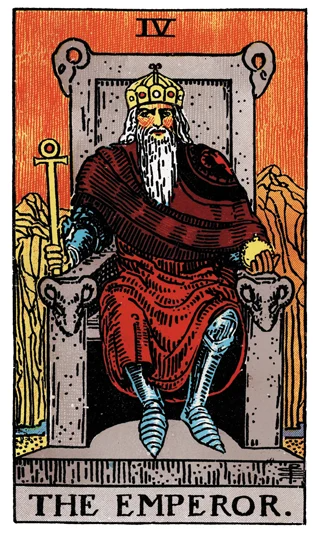
| The stone throne | The throne communicates permanence and resistance. It supports stability, but its hardness also warns that authority can become unresponsive. |
| The ram heads | The carved rams connect the figure with force, initiative and Aries. They reinforce the card's assertive, martial character. |
| The ankh-shaped sceptre | The sceptre resembles the Egyptian symbol of life. It associates the Emperor's worldly rule with the power to preserve and organise life. |
| The armour | Armour remains visible beneath the red robe. Even at rest, the figure is prepared for conflict, suggesting protection but also habitual defensiveness. |
| The barren mountains | The landscape is severe and exposed. It implies achievement through endurance, while contrasting with the fertile environment of the Empress. |
A. E. Waite's original description
He has a form of the Crux ansata for his sceptre and a globe in his left hand. He is a crowned monarch, commanding, stately, seated on a throne, the arms of which are fronted by rams' heads. He is executive and realization, the power of this world, here clothed with the highest of its natural attributes. He is occasionally represented as seated on a cubic stone, which, however, confuses some of the issues.
He is the virile power, to which the Empress responds, and in this sense is he who seeks to remove the Veil of Isis; yet she remains virgo intacta.
It should be understood that this card and that of the Empress do not precisely represent the condition of married life, though this state is implied. On the surface, as I have indicated, they stand for mundane royalty, uplifted on the seats of the mighty; but above this there is the suggestion of another presence. They signify also, and the male figure especially, the higher kingship, occupying the intellectual throne. Hereof is the lordship of thought rather than of the animal world. Both personalities, after their own manner, are “full of strange experience,” but theirs is not consciously the wisdom which draws from a higher world. The Emperor has been described as (a) will in its embodied form, but this is only one of its applications, and (b) as an expression of virtualities contained in the Absolute Being, but this is fantasy.
Waite's original divinatory meanings
Upright:
Stability, power, protection, realization; a great person; aid, reason, conviction; also authority and will.
Reversed:
Benevolence, compassion, credit; also confusion to enemies, obstruction, immaturity.
Source: A. E. Waite, The Pictorial Key to the Tarot, first published in 1910, with illustrations by Pamela Colman Smith.
Continue through the deck
- Previous card: The Empress
- Next card: The Hierophant
Written and interpreted by Finbarre Snarey, tarot researcher, founder of the British Tarot Archive and coordinator of the UK living heritage submission for Rider-Waite-Smith tarot reading practice.
These interpretations reflect Finbarre Snarey’s understanding of contemporary Rider-Waite-Smith tarot practice. They are provided for education, reflection and entertainment only and should not be treated as medical, legal, financial, psychological or relationship advice.