The Empress
Verdancy
“Nature never did betray the heart that loved her.”
Lines Written a Few Miles above Tintern Abbey
The Empress at a glance
Finbarre’s interpretation: The Empress represents growth, care, creativity and the conditions that allow life to flourish.
| Upright | abundance, nurture, creativity, fertility, embodiment |
|---|---|
| Reversed | depletion, overgiving, dependence, creative block, neglect |
| Linked card | Death |
| Soundtrack | Teardrop by Massive Attack, Elizabeth Fraser Open the full Tarot Interviews playlist on Spotify |
Upright meanings
- Abundance
- Nurture
- Creativity
- Fertility
- Embodiment
- Sustainable growth
- Sensual pleasure
- Practical care
- A supportive environment
- A project flourishing
Reversed meanings
- Depletion
- Overgiving
- Dependence
- Creative block
- Neglect
- Smothering care
- Unequal emotional labour
- Disconnection from the body
- Comfort spending
- Growth without boundaries
The Empress in a reading
| Area | Meaning |
|---|---|
| Love | Relationship energy: Affection expressed through presence and practical care. Reversed: Smothering, dependence or unequal emotional labour. |
| Career | Work: Development, design and patient cultivation. Warning: Growth attempted without adequate resources or rest. |
| Money | Financial theme: Investment in quality and sustainability. Warning: Comfort spending used to compensate for depletion. |
| Feelings | Upright: Warm, sensual and protective. Reversed: Drained, neglected or overly needed. |
| Advice | Prioritise: Create the conditions in which life can flourish. Watch for: Giving so much that care becomes depletion. |
| Outcome | Potential: Steady cultivation produces abundance. Obstacle: Neglect or overprotection prevents healthy growth. |
| Yes or no | Yes, particularly for growth, creativity and material development. |
Symbols in The Empress
| Symbol | Meaning |
|---|---|
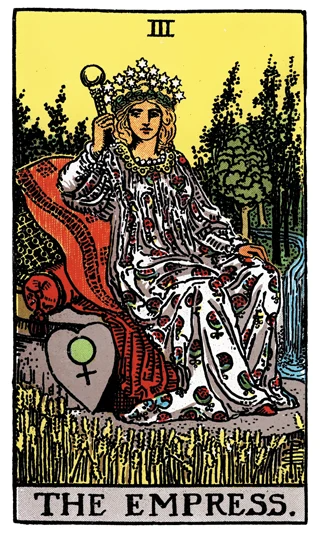
| The field of wheat | The ripe grain is a direct image of cultivation and harvest. It shows abundance as the result of sustained natural and human processes. |
| The flowing water | Water moves through the trees towards the foreground. It suggests emotional and creative life feeding the visible landscape. |
| The Venus shield | The heart-shaped shield bears the symbol of Venus, linking the card with attraction, beauty, pleasure and generative relationship. |
| The crown of twelve stars | The stars place the Empress within a larger cycle. They can suggest cosmic order, the months or zodiacal completeness surrounding earthly fertility. |
| The pomegranate-patterned robe | The fruit motif reinforces fertility and abundance while connecting the Empress visually with the veiled mysteries of the High Priestess. |
A. E. Waite's original description
A stately figure, seated, having rich vestments and royal aspect, as of a daughter of heaven and earth. Her diadem is of twelve stars, gathered in a cluster. The symbol of Venus is on the shield which rests near her. A field of corn is ripening in front of her, and beyond there is a fall of water. The sceptre which she bears is surmounted by the globe of this world. She is the inferior Garden of Eden, the Earthly Paradise, all that is symbolized by the visible house of man.
She is not Regina coeli, but she is still refugium peccatorum, the fruitful mother of thousands. There are also certain aspects in which she has been correctly described as desire and the wings thereof, as the woman clothed with the sun, as Gloria Mundi and the veil of the Sanctum Sanctorum; but she is not, I may add, the soul that has attained wings, unless all the symbolism is counted up another and unusual way. She is above all things universal fecundity and the outer sense of the Word. This is obvious, because there is no direct message which has been given to man like that which is borne by woman; but she does not herself carry its interpretation.
In another order of ideas, the card of the Empress signifies the door or gate by which an entrance is obtained into this life, as into the Garden of Venus; and then the way which leads out therefrom, into that which is beyond, is the secret known to the High Priestess: it is communicated by her to the elect. Most old attributions of this card are completely wrong on the symbolism, as, for example, its identification with the Word, Divine Nature, the Triad, and so forth.
Waite's original divinatory meanings
Upright:
Fruitfulness, action, initiative, length of days; the unknown, clandestine; also difficulty, doubt, ignorance.
Reversed:
Light, truth, the unravelling of involved matters, public rejoicings; according to another reading, vacillation.
Source: A. E. Waite, The Pictorial Key to the Tarot, first published in 1910, with illustrations by Pamela Colman Smith.
Continue through the deck
- Previous card: The High Priestess
- Next card: The Emperor
Written and interpreted by Finbarre Snarey, tarot researcher, founder of the British Tarot Archive and coordinator of the UK living heritage submission for Rider-Waite-Smith tarot reading practice.
These interpretations reflect Finbarre Snarey’s understanding of contemporary Rider-Waite-Smith tarot practice. They are provided for education, reflection and entertainment only and should not be treated as medical, legal, financial, psychological or relationship advice.