The High Priestess
Veiled
“The rest is silence.”
Hamlet
The High Priestess at a glance
Finbarre’s interpretation: The High Priestess represents intuition, hidden knowledge and the value of patient observation.
| Upright | intuition, mystery, silence, receptivity, inner knowledge |
|---|---|
| Reversed | disconnection, concealment, superficiality, confusion, ignored intuition |
| Linked card | The Hanged Man |
| Soundtrack | Dancing Barefoot by Patti Smith Open the full Tarot Interviews playlist on Spotify |
Upright meanings
- Intuition
- Hidden knowledge
- Patient observation
- Silence
- Receptivity
- Confidential information
- Inner certainty
- Research
- A developing answer
- Protective privacy
Reversed meanings
- Ignored intuition
- Unhelpful secrecy
- Surface knowledge
- Confusion
- Emotional withdrawal
- Mixed signals
- Premature disclosure
- Projection
- Disconnection from inner judgement
- Information used as power
The High Priestess in a reading
| Area | Meaning |
|---|---|
| Love | Relationship energy: Quiet significance or unspoken feelings. Reversed: Mixed signals, withheld information or chronic ambiguity. |
| Career | Work: Research, confidential matters and strategic patience. Warning: Acting before the necessary information is available. |
| Money | Financial theme: Investigate what is not being shown. Warning: Rumour, projection or intuition treated as proof. |
| Feelings | Upright: Private, observant and deeply receptive. Reversed: Confused, withdrawn or unable to trust inner judgement. |
| Advice | Prioritise: Listen and investigate before responding. Watch for: Forcing certainty simply to end discomfort. |
| Outcome | Potential: The truth emerges with time. Obstacle: Secrecy or projection keeps the situation unreadable. |
| Yes or no | Not yet; more information or reflection is needed. |
Symbols in The High Priestess
| Symbol | Meaning |
|---|---|
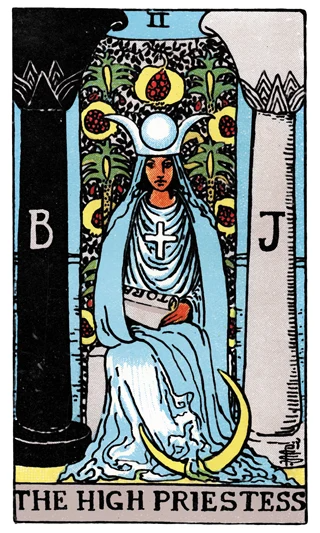
| The black and white pillars | The pillars marked B and J refer to Boaz and Jachin at the entrance to Solomon's Temple. Visually, they create a threshold between opposites and place the figure in a mediating position. |
| The veil | The patterned veil blocks direct access to the water beyond. It suggests that hidden knowledge is not absent, but screened from ordinary view. |
| The pomegranates and palms | The veil's plants evoke fertility, sacred enclosure and the meeting of generative and spiritual symbolism. They also connect the card with the Empress. |
| The scroll marked Tora | The partly covered scroll represents law, teaching and knowledge that is both revealed and concealed. The spelling encourages several layers of association without resolving them into one answer. |
| The moon | The crescent at her feet and the flowing blue garment link the card with reflected light, cycles, receptivity and the unconscious. |
A. E. Waite's original description
She has the lunar crescent at her feet, a horned diadem on her head, with a globe in the middle place, and a large solar cross on her breast. The scroll in her hands is inscribed with the word Tora, signifying the Greater Law, the Secret Law and the second sense of the Word. It is partly covered by her mantle, to shew that some things are implied and some spoken. She is seated between the white and black pillars, J. and B., of the mystic Temple and the veil of the Temple is behind her: it is embroidered with palms and pomegranates. The vestments are flowing and gauzy, and the mantle suggests light, a shimmering radiance. She has been called Occult Science on the threshold of the Sanctuary of Isis, but she is really the Secret Church, the House which is of God and man. She represents also the Second Marriage of the Prince who is no longer of this world; she is the spiritual Bride and Mother, the daughter of the stars and the Higher Garden of Eden. She is, in fine, the Queen of the borrowed light, but this is the light of all. She is the Moon nourished by the milk of the Supernal Mother.
In a manner, she is also the Supernal Mother herself, that is to say, she is the bright reflection. It is in this sense of reflection that her truest and highest name in symbolism is Shekinah, the co-habiting glory. According to Kabalism, there is a Shekinah both above and below. In the superior world it is called Binah, the Supernal Understanding which reflects to the emanations that are beneath. In the lower world it is Malkuth, that world being, for this purpose, understood as a blessed Kingdom, that with which it is made blessed being the Indwelling Glory. Mystically speaking, the Shekinah is the Spiritual Bride of the just man, and when he reads the Law she gives the Divine meaning. There are some respects in which this card is the highest and holiest of the Greater Arcana.
Waite's original divinatory meanings
Upright:
Secrets, mystery, the future as yet unrevealed; the woman who interests the Querent, if male; the Querent herself, if female; silence, tenacity; mystery, wisdom, science.
Reversed:
Passion, moral or physical ardour, conceit, surface knowledge.
Source: A. E. Waite, The Pictorial Key to the Tarot, first published in 1910, with illustrations by Pamela Colman Smith.
Continue through the deck
- Previous card: The Magician
- Next card: The Empress
Written and interpreted by Finbarre Snarey, tarot researcher, founder of the British Tarot Archive and coordinator of the UK living heritage submission for Rider-Waite-Smith tarot reading practice.
These interpretations reflect Finbarre Snarey’s understanding of contemporary Rider-Waite-Smith tarot practice. They are provided for education, reflection and entertainment only and should not be treated as medical, legal, financial, psychological or relationship advice.