The Moon
Penumbra
“Ill met by moonlight, proud Titania.”
A Midsummer Night’s Dream
The Moon at a glance
Finbarre’s interpretation: The Moon represents uncertainty, imagination and the fears or intuitions that become active when the way ahead is only partly visible.
| Upright | uncertainty, imagination, dream, fear, illusion |
|---|---|
| Reversed | disclosure, reduced confusion, lingering anxiety, denial, misreading |
| Linked card | Strength |
| Soundtrack | White Rabbit by Jefferson Airplane Open the full Tarot Interviews playlist on Spotify |
Upright meanings
- Uncertainty
- Imagination
- Dreams
- Fear
- Illusion
- Incomplete information
- Heightened instinct
- Anxiety in ambiguity
- The unconscious surfacing
- A path that cannot yet be seen clearly
Reversed meanings
- Disclosure
- Reduced confusion
- Lingering anxiety
- Denial
- Misreading
- A secret emerging
- Fear beginning to recede
- Self-deception
- Confusion becoming visible
- Premature certainty
The Moon in a reading
| Area | Meaning |
|---|---|
| Love | Relationship energy: Strong intuition and uncertain signals. Reversed: A hidden issue emerging or confusion beginning to clear. |
| Career | Work: Ambiguous conditions requiring verification. Warning: Rumour, anxiety or imagination being treated as evidence. |
| Money | Financial theme: Delay action until figures and terms are clear. Warning: Hidden costs, misleading impressions or fear-based decisions. |
| Feelings | Upright: Anxious, imaginative and unsure what is real. Reversed: Still unsettled, but beginning to see through the fog. |
| Advice | Prioritise: Move carefully and test impressions against evidence. Watch for: Demanding a certainty the situation cannot yet provide. |
| Outcome | Potential: The path becomes clearer one stage at a time. Obstacle: Fear or illusion distorts what is actually present. |
| Yes or no | Unclear; do not decide until the uncertainty has been investigated. |
Symbols in The Moon
| Symbol | Meaning |
|---|---|
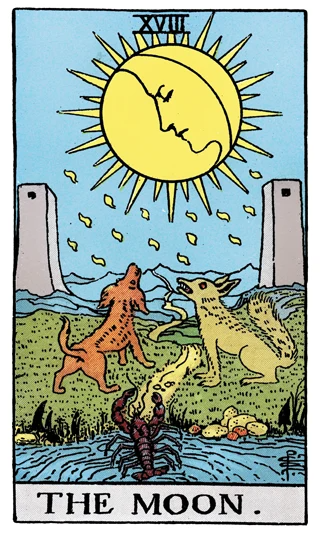
| The moon's changing face | A profile appears within the lunar disc, surrounded by both rays and falling drops. The image combines observation, reflection and a world affected by indirect light. |
| The dog and wolf | The domesticated and wild animals respond together. They suggest different forms of instinct becoming vocal in the presence of uncertainty. |
| The crayfish | The creature rises from deep water at the start of the path. It represents primitive material, fear or awareness emerging slowly from the unconscious. |
| The two towers | The matching towers frame the exit from familiar territory. They mark a threshold into a landscape that cannot be fully surveyed. |
| The winding path | The road continues beyond sight, reminding the reader that uncertainty is navigated step by step rather than resolved from the starting point. |
A. E. Waite's original description
The distinction between this card and some of the conventional types is that the moon is increasing on what is called the side of mercy, to the right of the observer. It has sixteen chief and sixteen secondary rays. The card represents life of the imagination apart from life of the spirit. The path between the towers is the issue into the unknown. The dog and wolf are the fears of the natural mind in the presence of that place of exit, when there is only reflected light to guide it.
The last reference is a key to another form of symbolism. The intellectual light is a reflection and beyond it is the unknown mystery which it cannot shew forth. It illuminates our animal nature, types of which are represented below, the dog, the wolf and that which comes up out of the deeps, the nameless and hideous tendency which is lower than the savage beast. It strives to attain manifestation, symbolized by crawling from the abyss of water to the land, but as a rule it sinks back whence it came.
The face of the mind directs a calm gaze upon the unrest below; the dew of thought falls; the message is: Peace, be still; and it may be that there shall come a calm upon the animal nature, while the abyss beneath shall cease from giving up a form.
Waite's original divinatory meanings
Upright:
Hidden enemies, danger, calumny, darkness, terror, deception, occult forces, error.
Reversed:
Instability, inconstancy, silence, lesser degrees of deception and error.
Source: A. E. Waite, The Pictorial Key to the Tarot, first published in 1910, with illustrations by Pamela Colman Smith.
Continue through the deck
Written and interpreted by Finbarre Snarey, tarot researcher, founder of the British Tarot Archive and coordinator of the UK living heritage submission for Rider-Waite-Smith tarot reading practice.
These interpretations reflect Finbarre Snarey’s understanding of contemporary Rider-Waite-Smith tarot practice. They are provided for education, reflection and entertainment only and should not be treated as medical, legal, financial, psychological or relationship advice.