The Chariot
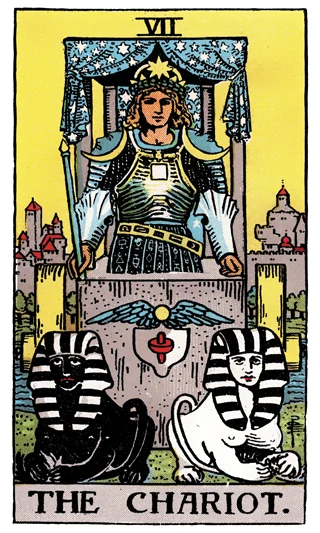
Advance
“Once more unto the breach, dear friends, once more.”
Henry V
The Chariot at a glance
Finbarre’s interpretation: The Chariot represents direction, determination and the control required to sustain momentum.
| Upright | determination, direction, momentum, discipline, victory |
|---|---|
| Reversed | drift, aggression, obstruction, poor control, divided purpose |
| Linked card | The Star |
| Soundtrack | Running Up That Hill (A Deal With God) by Kate Bush Open the full Tarot Interviews playlist on Spotify |
Upright meanings
- Determination
- Direction
- Momentum
- Discipline
- Victory
- Focused action
- Coordinated effort
- Travel
- Competitive success
- Command under pressure
Reversed meanings
- Drift
- Aggression
- Obstruction
- Poor control
- Divided purpose
- Power struggle
- Travel disruption
- Force without direction
- Excessive control
- Momentum being lost
The Chariot in a reading
| Area | Meaning |
|---|---|
| Love | Relationship energy: Moving decisively towards a shared goal. Reversed: Power struggles or incompatible directions. |
| Career | Work: Campaigns, launches, travel and competition. Warning: Intense activity without a defined destination. |
| Money | Financial theme: Disciplined action towards a measurable target. Warning: Ambition justifying uncontrolled risk or spending. |
| Feelings | Upright: Determined, focused and ready to pursue. Reversed: Frustrated, combative or pulled in different directions. |
| Advice | Prioritise: Define the destination and coordinate competing forces. Watch for: Applying more force to an unclear plan. |
| Outcome | Potential: Momentum produces visible progress. Obstacle: Divided motives or poor control cause derailment. |
| Yes or no | Yes, if you can maintain direction and self-control. |
Symbols in The Chariot
| Symbol | Meaning |
|---|---|
| The black and white sphinxes | The contrasting creatures embody opposing impulses, conditions or forms of knowledge. Their stillness suggests that direction comes from the charioteer's command rather than visible reins. |
| The starry canopy | The canopy places celestial imagery above the vehicle. It connects worldly movement with a larger design or ambition. |
| The city behind | The fortified city marks the secure world being left behind. The journey takes the figure beyond established protection and identity. |
| The armour | The charioteer's armour combines defence, status and symbolic decoration. It shows readiness for conflict, but also the emotional distance required by command. |
| The square and winged emblem | The square on the chest suggests material order, while the winged form on the front of the chariot introduces movement of mind or spirit into the solid vehicle. |
A. E. Waite's original description
An erect and princely figure carrying a drawn sword and corresponding, broadly speaking, to the traditional description which I have given in the first part. On the shoulders of the victorious hero are supposed to be the Urim and Thummim. He has led captivity captive; he is conquest on all planes, in the mind, in science, in progress, in certain trials of initiation.
He has thus replied to the sphinx, and it is on this account that I have accepted the variation of Éliphas Lévi; two sphinxes thus draw his chariot. He is above all things triumph in the mind.
It is to be understood for this reason (a) that the question of the sphinx is concerned with a Mystery of Nature and not of the world of Grace, to which the charioteer could offer no answer; (b) that the planes of his conquest are manifest or external and not within himself; (c) that the liberation which he effects may leave himself in the bondage of the logical understanding; (d) that the tests of initiation through which he has passed in triumph are to be understood physically or rationally; and (e) that if he came to the pillars of that Temple between which the High Priestess is seated, he could not open the scroll called Tora, nor if she questioned him could he answer. He is not hereditary royalty and he is not priesthood.
Waite's original divinatory meanings
Upright:
Succour, providence; also war, triumph, presumption, vengeance, trouble.
Reversed:
Riot, quarrel, dispute, litigation, defeat.
Source: A. E. Waite, The Pictorial Key to the Tarot, first published in 1910, with illustrations by Pamela Colman Smith.
Continue through the deck
- Previous card: The Lovers
- Next card: Strength
Written and interpreted by Finbarre Snarey, tarot researcher, founder of the British Tarot Archive and coordinator of the UK living heritage submission for Rider-Waite-Smith tarot reading practice.
These interpretations reflect Finbarre Snarey’s understanding of contemporary Rider-Waite-Smith tarot practice. They are provided for education, reflection and entertainment only and should not be treated as medical, legal, financial, psychological or relationship advice.