Queen of Swords
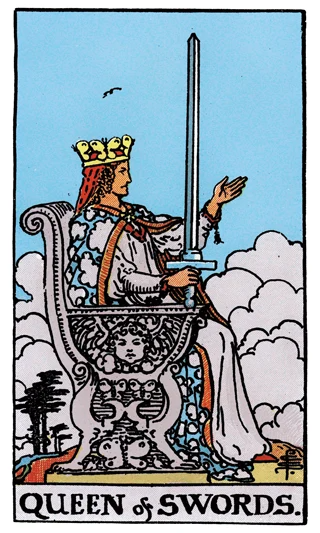
Acuity
“Above all, be the heroine of your life, not the victim.”
Nora Ephron
Queen of Swords at a glance
Finbarre’s interpretation: The Queen of Swords joins clear judgement with experience of loss, refusing both sentimentality and unnecessary cruelty.
| Upright | discernment, independence, honest boundaries, perceptive judgement, direct communication |
|---|---|
| Reversed | bitterness, cruelty, suspicion, isolation, prejudice |
| Linked card | Justice |
| Soundtrack | labour by Paris Paloma Open the full Tarot Interviews playlist on Spotify |
Upright meanings
- Discernment
- Independence
- Honest boundaries
- Perceptive judgement
- Direct communication
- Resilience after sorrow
- Intellectual authority
- Fair criticism
- Self-respect
- Seeing through pretence
Reversed meanings
- Bitterness
- Cruelty
- Suspicion
- Isolation
- Prejudice
- Weaponised intelligence
- Rigid judgement
- Deceit
- Grief becoming identity
- Rejecting tenderness
Queen of Swords in a reading
| Area | Meaning |
|---|---|
| Love | Communication: Resilience after sorrow. Reversed: Weaponised intelligence. |
| Career | Work: Intellectual authority; fair criticism. Warning: Rigid judgement. |
| Money | Financial theme: Self-respect. Warning: Grief becoming identity. |
| Feelings | Upright: Honest boundaries. Reversed: Suspicion. |
| Advice | Prioritise: Seeing through pretence. Watch for: Rejecting tenderness. |
| Outcome | Potential: Direct communication. Obstacle: Prejudice. |
| Yes or no | Yes, if the answer survives honest examination. |
Symbols in Queen of Swords
| Symbol | Meaning |
|---|---|
| The upright sword | Her judgement is explicit and ready to be used. |
| The extended hand | A hearing or invitation remains possible despite severity. |
| The windblown trees | Experience has shaped rather than sheltered her. |
| The single bird | Independence may provide clarity but can also become isolation. |
A. E. Waite's original description
Her right hand raises the weapon vertically and the hilt rests on an arm of her royal chair; the left hand is extended, the arm raised; her countenance is severe but chastened; it suggests familiarity with sorrow. It does not represent mercy, and, her sword notwithstanding, she is scarcely a symbol of power.
Waite's original divinatory meanings
Upright:
Widowhood, female sadness and embarrassment, absence, sterility, mourning, privation, separation.
Reversed:
Malice, bigotry, artifice, prudery, bale, deceit.
Source: A. E. Waite, The Pictorial Key to the Tarot, first published in 1910, with illustrations by Pamela Colman Smith.
Continue through the deck
- Previous card: Knight of Swords
- Next card: King of Swords
Written and interpreted by Finbarre Snarey, tarot researcher, founder of the British Tarot Archive and coordinator of the UK living heritage submission for Rider-Waite-Smith tarot reading practice.
These interpretations reflect Finbarre Snarey’s understanding of contemporary Rider-Waite-Smith tarot practice. They are provided for education, reflection and entertainment only and should not be treated as medical, legal, financial, psychological or relationship advice.