Five of Swords
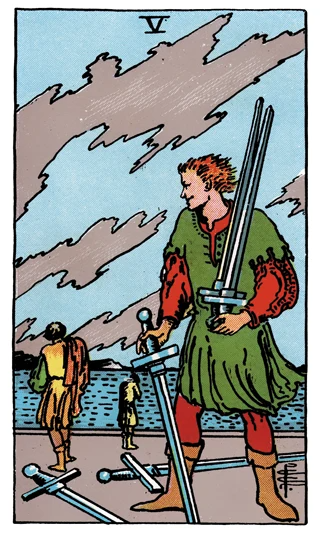
Pyrrhic
“When elephants fight, it is the grass that suffers.”
Kikuyu proverb
Five of Swords at a glance
Finbarre’s interpretation: The Five of Swords asks what a victory is worth when trust, dignity or future cooperation has been damaged.
| Upright | conflict with consequences, recognising a hollow victory, strategic withdrawal, exposing bad faith, surviving hostility |
|---|---|
| Reversed | revenge, repeated conflict, refusal to apologise, humiliation, bullying |
| Linked card | Seven of Swords |
| Soundtrack | The Killing Moon by Echo & the Bunnymen Open the full Tarot Interviews playlist on Spotify |
Upright meanings
- Conflict with consequences
- Recognising a hollow victory
- Strategic withdrawal
- Exposing bad faith
- Surviving hostility
- Setting limits after betrayal
- Learning from defeat
- Refusing humiliation
- Understanding power tactics
- Choosing which battles matter
Reversed meanings
- Revenge
- Repeated conflict
- Refusal to apologise
- Humiliation
- Bullying
- Unresolved defeat
- Self-sabotage
- Bitterness
- Winning through cruelty
- Reconciliation without accountability
Five of Swords in a reading
| Area | Meaning |
|---|---|
| Love | Communication: Setting limits after betrayal. Reversed: Unresolved defeat. |
| Career | Work: Learning from defeat; refusing humiliation. Warning: Self-sabotage. |
| Money | Financial theme: Understanding power tactics. Warning: Winning through cruelty. |
| Feelings | Upright: Strategic withdrawal. Reversed: Refusal to apologise. |
| Advice | Prioritise: Choosing which battles matter. Watch for: Reconciliation without accountability. |
| Outcome | Potential: Surviving hostility. Obstacle: Bullying. |
| Yes or no | No, unless the method and cost of winning change. |
Symbols in Five of Swords
| Symbol | Meaning |
|---|---|
| The gathered swords | The apparent winner possesses the tools left behind by others. |
| The retreating figures | Defeat has an emotional and relational cost. |
| The smirking expression | Pleasure in dominance makes reconciliation less likely. |
| The turbulent sky | The argument may be over, but the atmosphere remains unsettled. |
A. E. Waite's original description
A disdainful man looks after two retreating and dejected figures. Their swords lie upon the ground. He carries two others on his left shoulder, and a third sword is in his right hand, point to earth. He is the master in possession of the field.
Waite's original divinatory meanings
Upright:
Degradation, destruction, revocation, infamy, dishonour, loss, with the variants and analogues of these.
Reversed:
The same; burial and obsequies.
Source: A. E. Waite, The Pictorial Key to the Tarot, first published in 1910, with illustrations by Pamela Colman Smith.
Continue through the deck
- Previous card: Four of Swords
- Next card: Six of Swords
Written and interpreted by Finbarre Snarey, tarot researcher, founder of the British Tarot Archive and coordinator of the UK living heritage submission for Rider-Waite-Smith tarot reading practice.
These interpretations reflect Finbarre Snarey’s understanding of contemporary Rider-Waite-Smith tarot practice. They are provided for education, reflection and entertainment only and should not be treated as medical, legal, financial, psychological or relationship advice.