Three of Swords
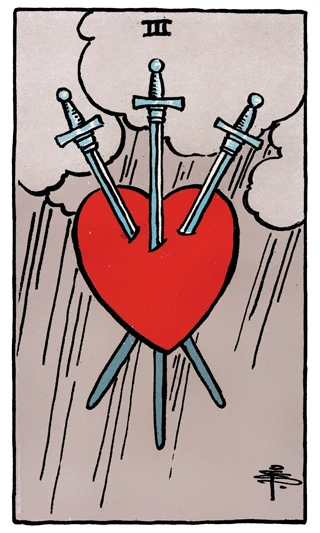
Laceration
“Love will tear us apart.”
Love Will Tear Us Apart, Joy Division
Three of Swords at a glance
Finbarre’s interpretation: The Three of Swords gives pain a clear image so that it can be acknowledged rather than disguised.
| Upright | heartbreak, grief, painful truth, separation, disappointment |
|---|---|
| Reversed | healing beginning, prolonged grief, denial of pain, recurring hurt, confusion |
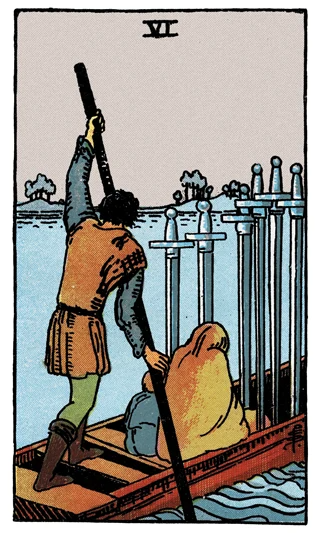
| Linked card | Six of Swords |
| Soundtrack | Back To Black by Amy Winehouse Open the full Tarot Interviews playlist on Spotify |
Upright meanings
- Heartbreak
- Grief
- Painful truth
- Separation
- Disappointment
- Emotional release
- Naming hurt
- Necessary sorrow
- Conflict reaching the heart
- Accepting an unwelcome fact
Reversed meanings
- Healing beginning
- Prolonged grief
- Denial of pain
- Recurring hurt
- Confusion
- Self-blame
- Difficulty forgiving
- Private sorrow
- Reconciliation after honesty
- An old wound shaping the present
Three of Swords in a reading
| Area | Meaning |
|---|---|
| Love | Communication: Emotional release. Reversed: Self-blame. |
| Career | Work: Naming hurt; necessary sorrow. Warning: Difficulty forgiving. |
| Money | Financial theme: Conflict reaching the heart. Warning: Reconciliation after honesty. |
| Feelings | Upright: Painful truth. Reversed: Denial of pain. |
| Advice | Prioritise: Accepting an unwelcome fact. Watch for: An old wound shaping the present. |
| Outcome | Potential: Disappointment. Obstacle: Confusion. |
| Yes or no | No in its present form; honesty may begin recovery. |
Symbols in Three of Swords
| Symbol | Meaning |
|---|---|
| The pierced heart | Emotional pain is shown directly without narrative distraction. |
| The three swords | Several facts, people or thoughts converge on the same wound. |
| The rain | Grief occupies the whole atmosphere rather than a private corner. |
| The clouds | Understanding is present, but comfort and perspective are limited. |
A. E. Waite's original description
Three swords piercing a heart; cloud and rain behind.
Waite's original divinatory meanings
Upright:
Removal, absence, delay, division, rupture, dispersion, and all that the design signifies naturally, being too simple and obvious to call for specific enumeration.
Reversed:
Mental alienation, error, loss, distraction, disorder, confusion.
Source: A. E. Waite, The Pictorial Key to the Tarot, first published in 1910, with illustrations by Pamela Colman Smith.
Continue through the deck
- Previous card: Two of Swords
- Next card: Four of Swords
Written and interpreted by Finbarre Snarey, tarot researcher, founder of the British Tarot Archive and coordinator of the UK living heritage submission for Rider-Waite-Smith tarot reading practice.
These interpretations reflect Finbarre Snarey’s understanding of contemporary Rider-Waite-Smith tarot practice. They are provided for education, reflection and entertainment only and should not be treated as medical, legal, financial, psychological or relationship advice.