The Fool
Uncharted
“Not all those who wander are lost.”
The Fellowship of the Ring
The Fool at a glance
Finbarre’s interpretation: The Fool represents new beginnings, openness and the willingness to step into the unknown.
| Upright | beginnings, freedom, curiosity, trust, spontaneity |
|---|---|
| Reversed | recklessness, hesitation, naivety, distraction, avoidable risk |
| Linked card | The World |
| Soundtrack | Mr. Blue Sky by Electric Light Orchestra Open the full Tarot Interviews playlist on Spotify |
Upright meanings
- A new beginning
- Freedom to explore
- Spontaneous choice
- Trust in the process
- Curiosity
- Travel or adventure
- A fresh identity
- Experimentation
- Openness to experience
- An intelligent risk
Reversed meanings
- A reckless decision
- Avoidable risk
- Naivety
- Poor preparation
- Distraction
- Impulsive escape
- Inconsistency
- Fear of beginning
- Paralysis at the threshold
- Consequences being ignored
The Fool in a reading
| Area | Meaning |
|---|---|
| Love | Relationship energy: A new connection or a lighter phase. Reversed: Inconsistency or impulsive attachment. |
| Career | Work: A new role, project or experiment. Warning: Enthusiasm replacing preparation. |
| Money | Financial theme: A proportionate risk or unfamiliar opportunity. Warning: Impulsive spending or unchecked commitments. |
| Feelings | Upright: Excited, curious and open. Reversed: Restless, hesitant or unreliable. |
| Advice | Prioritise: Take the first informed step. Watch for: Confusing freedom with freedom from consequences. |
| Outcome | Potential: A new path opens. Obstacle: Fear or recklessness prevents a clean beginning. |
| Yes or no | Yes, provided the risk is understood rather than ignored. |
Symbols in The Fool
| Symbol | Meaning |
|---|---|
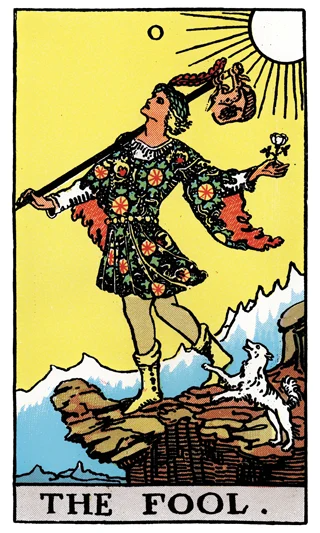
| The cliff | The precipice makes risk visible. It can represent the unknown consequences of a choice, but also the point beyond which life cannot be controlled entirely in advance. |
| The white dog | The dog appears alert and active beside the traveller. It may be read as instinct, companionship, warning or encouragement, depending on how the scene is understood. |
| The white rose | The pale rose suggests innocence, openness and an intention not yet complicated by experience. It also contrasts with the physical danger of the cliff. |
| The bundle and staff | The small bundle implies that The Fool travels lightly. He carries something from the past, but not enough to prevent movement into a new life. |
| The mountains | The distant mountains suggest challenges and development beyond the immediate leap. The beginning is only the first stage of a much longer journey. |
A. E. Waite's original description
With light step, as if earth and its trammels had little power to restrain him, a young man in gorgeous vestments pauses at the brink of a precipice among the great heights of the world; he surveys the blue distance before him, its expanse of sky rather than the prospect below. His act of eager walking is still indicated, though he is stationary at the given moment; his dog is still bounding. The edge which opens on the depth has no terror; it is as if angels were waiting to uphold him, if it came about that he leaped from the height. His countenance is full of intelligence and expectant dream. He has a rose in one hand and in the other a costly wand, from which depends over his right shoulder a wallet curiously embroidered. He is a prince of the other world on his travels through this one, all amidst the morning glory, in the keen air.
The sun, which shines behind him, knows whence he came, whither he is going, and how he will return by another path after many days. He is the spirit in search of experience. Many symbols of the Instituted Mysteries are summarized in this card, which reverses, under high warrants, all the confusions that have preceded it.
In his Manual of Cartomancy, Grand Orient has a curious suggestion of the office of Mystic Fool, as a part of his process in higher divination; but it might call for more than ordinary gifts to put it into operation. We shall see how the card fares according to the common arts of fortune-telling, and it will be an example, to those who can discern, of the fact, otherwise so evident, that the Trumps Major had no place originally in the arts of psychic gambling, when cards are used as the counters and pretexts. Of the circumstances under which this art arose we know, however, very little. The conventional explanations say that the Fool signifies the flesh, the sensitive life, and by a peculiar satire its subsidiary name was at one time the alchemist, as depicting folly at the most insensate stage.
Waite's original divinatory meanings
Upright:
Folly, mania, extravagance, intoxication, delirium, frenzy, bewrayment.
Reversed:
Negligence, absence, distribution, carelessness, apathy, nullity, vanity.
Source: A. E. Waite, The Pictorial Key to the Tarot, first published in 1910, with illustrations by Pamela Colman Smith.
Continue through the deck
- Previous card: The World
- Next card: The Magician
Written and interpreted by Finbarre Snarey, tarot researcher, founder of the British Tarot Archive and coordinator of the UK living heritage submission for Rider-Waite-Smith tarot reading practice.
These interpretations reflect Finbarre Snarey’s understanding of contemporary Rider-Waite-Smith tarot practice. They are provided for education, reflection and entertainment only and should not be treated as medical, legal, financial, psychological or relationship advice.