Five of Wands
Contest
“There are no two words in the English language more harmful than ‘good job’.”
Whiplash
Five of Wands at a glance
Finbarre’s interpretation: The Five of Wands describes friction that tests skill, status and the ability to cooperate.
| Upright | competition, lively debate, testing ability, conflicting priorities, creative tension |
|---|---|
| Reversed | hostile conflict, avoidance of necessary debate, dirty tactics, litigation, unresolved tension |
| Linked card | Seven of Wands |
| Soundtrack | War by Edwin Starr Open the full Tarot Interviews playlist on Spotify |
Upright meanings
- Competition
- Lively debate
- Testing ability
- Conflicting priorities
- Creative tension
- Practice through opposition
- A crowded field
- Energetic disagreement
- Learning through challenge
- Productive rivalry
Reversed meanings
- Hostile conflict
- Avoidance of necessary debate
- Dirty tactics
- Litigation
- Unresolved tension
- Group dysfunction
- Suppressed resentment
- Pointless argument
- Confusion about roles
- Victory at excessive cost
Five of Wands in a reading
| Area | Meaning |
|---|---|
| Love | Relationship energy: Practice through opposition. Reversed: Group dysfunction. |
| Career | Work: A crowded field; energetic disagreement. Warning: Suppressed resentment. |
| Money | Financial theme: Learning through challenge. Warning: Confusion about roles. |
| Feelings | Upright: Testing ability. Reversed: Dirty tactics. |
| Advice | Prioritise: Productive rivalry. Watch for: Victory at excessive cost. |
| Outcome | Potential: Creative tension. Obstacle: Unresolved tension. |
| Yes or no | Not yet. Competition or disagreement must be worked through. |
Symbols in Five of Wands
| Symbol | Meaning |
|---|---|
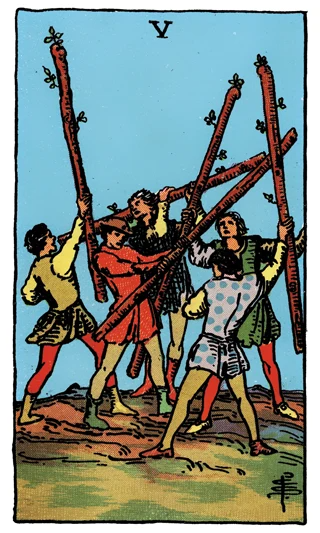
| The crossed staves | Different aims collide without a single agreed direction. |
| The varied clothing | Each participant brings a distinct position or identity. |
| The open ground | There is no formal structure containing the struggle. |
| The youthful figures | The scene can be practice, play or conflict depending on conduct. |
A. E. Waite's original description
A posse of youths, who are brandishing staves, as if in sport or strife. It is mimic warfare.
Waite's original divinatory meanings
Upright:
Imitation, as, for example, sham fight, but also the strenuous competition and struggle of the search after riches and fortune. In this sense it connects with the battle of life. Hence some attributions say that it is a card of gold, gain, opulence.
Reversed:
Litigation, disputes, trickery, contradiction.
Source: A. E. Waite, The Pictorial Key to the Tarot, first published in 1910, with illustrations by Pamela Colman Smith.
Continue through the deck
- Previous card: Four of Wands
- Next card: Six of Wands
Written and interpreted by Finbarre Snarey, tarot researcher, founder of the British Tarot Archive and coordinator of the UK living heritage submission for Rider-Waite-Smith tarot reading practice.
These interpretations reflect Finbarre Snarey’s understanding of contemporary Rider-Waite-Smith tarot practice. They are provided for education, reflection and entertainment only and should not be treated as medical, legal, financial, psychological or relationship advice.